
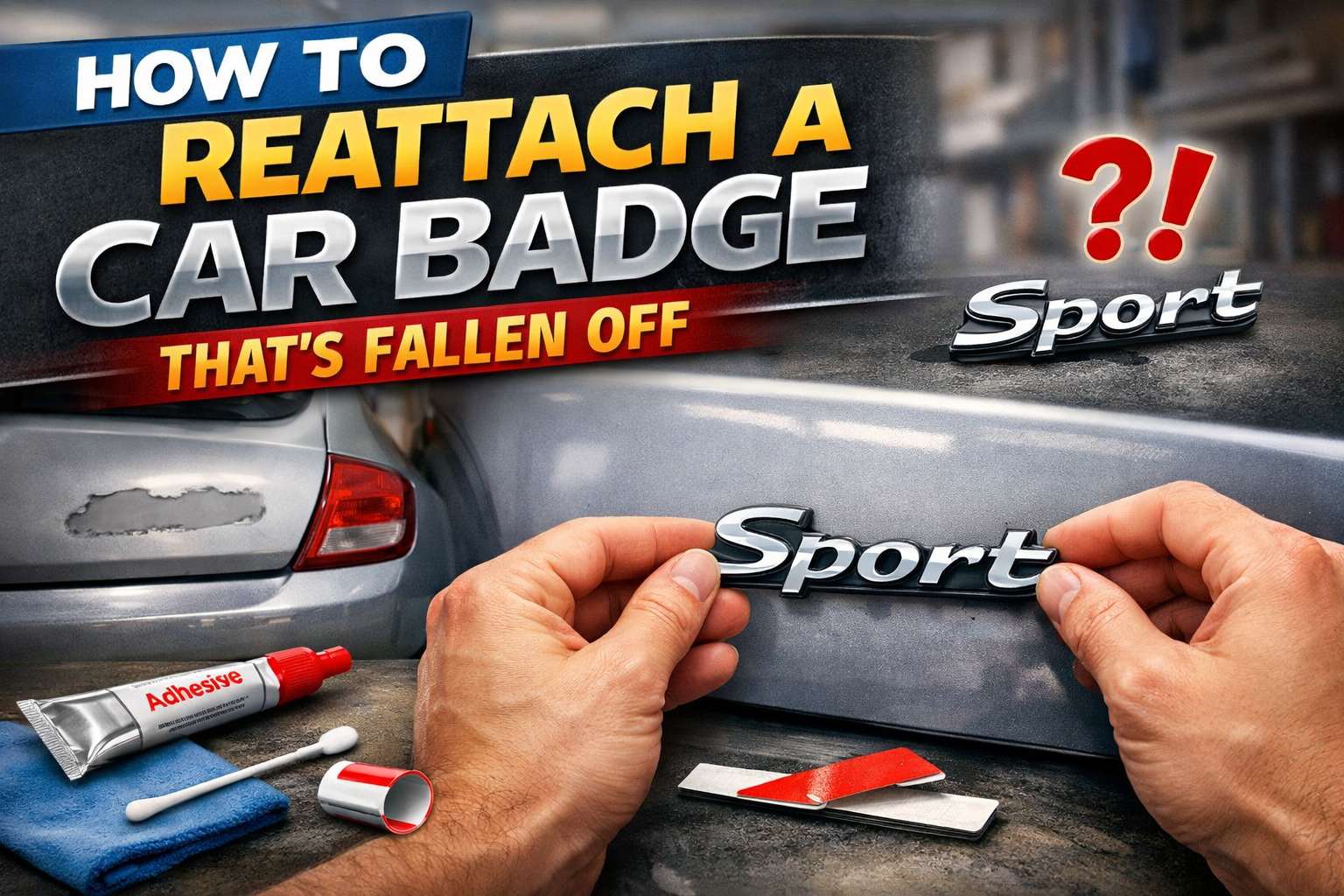
How to Reattach a Car Badge That’s Fallen Off
A missing car badge is one of those small things that makes a vehicle look neglected — and once you’ve noticed the bare patch of paint where your manufacturer emblem or model badge used to sit, you can’t stop seeing it. The good news is that reattaching a car badge is a straightforward job that takes about 15 minutes and doesn’t require a trip to the garage.
The key is using the right adhesive. Grab the wrong product and you’ll be doing this job again in a few weeks. Use the right automotive tape and the badge will stay put for years — through car washes, summer heat, winter frost, and thousands of miles of road vibration.
This guide covers why badges fall off in the first place, how to clean the surface properly, which tape to use, how to cut it to shape, and a step-by-step walkthrough of the reattachment process.
Why Do Car Badges Fall Off?
Before reaching for the tape, it’s worth understanding why the badge came loose — because the same thing will happen again if you don’t address the cause.
Factory adhesive degradation. Most car badges are bonded to the bodywork at the factory with a foam adhesive pad or strip. Over time — typically 5 to 15 years depending on climate and parking habits — this adhesive gradually breaks down. UV exposure, temperature cycling, moisture ingress, and the natural ageing of the adhesive compound all contribute. Eventually the bond weakens to the point where the badge lifts at the edges, catches the wind at speed, and detaches completely.
Car wash damage. Automated car washes with spinning brushes and high-pressure jets are a common trigger. The mechanical force of the brushes can catch a badge that’s already starting to lift, and the pressure washer can drive water under the edges of weakened adhesive. Many drivers find their badge missing after a car wash — the wash didn’t cause the failure directly, but it finished off a bond that was already on its way out.
UV breakdown. Badges on south-facing panels — particularly boot lids, tailgates, and bonnets — absorb more UV radiation than those in sheltered positions. UV is the primary enemy of rubber-based adhesives. If your badge was originally bonded with a rubber adhesive (common on older vehicles), years of sun exposure will have turned it brittle and chalky, destroying its grip.
Temperature cycling. The repeated expansion and contraction of metal bodywork through hot days and cold nights creates shear stress on the adhesive bond. Over thousands of cycles, this gradually fatigues the adhesive layer — particularly on large, flat badges where the thermal movement is greatest.
Impact or snagging. Sometimes a badge is simply knocked off — by a shopping trolley in a car park, a branch in a narrow lane, or a brush with undergrowth. If the adhesive was already weakened, even a minor knock can be enough to dislodge it.
Step 1: Remove Old Adhesive Residue
Before you can reattach the badge, both surfaces — the back of the badge and the bodywork — need to be clean and completely free of old adhesive. New tape bonded over old residue will grip the residue rather than the surface underneath, and the residue will eventually fail, taking your badge with it.
On the Bodywork
Start by assessing what’s left on the paint. You’ll typically see a ghost outline of the badge — a patch of cleaner paint surrounded by slightly faded or dirty paintwork — with remnants of old foam adhesive stuck to it.
For soft, gummy residue: Apply isopropyl alcohol (IPA) or a dedicated adhesive remover to a microfibre cloth and rub firmly. Most fresh-ish residue will dissolve and lift with IPA alone. For stubborn patches, apply the remover, let it soak for 2–3 minutes, then rub again.
For hard, dried residue: Use a plastic trim tool or an old credit card to gently scrape away the bulk of the material. Don’t use metal scrapers, razor blades, or wire wool — all of these will scratch the clear coat. Once you’ve removed the raised residue, clean the remainder with IPA.
For baked-on residue that won’t shift: A clay bar is the safest option for painted bodywork. Lubricate the area with clay bar spray or a mix of water and car shampoo, then rub the clay bar across the surface in straight lines. The clay picks up bonded contaminants without damaging the paint. Follow up with an IPA wipe.
Once clean, the paint should feel completely smooth to the touch with no tackiness or texture from old adhesive.
On the Back of the Badge
The back of the badge needs the same treatment. Peel off any remaining old foam tape or adhesive pads by hand, then clean the mounting surface with IPA on a cloth. Pay attention to the edges and corners — old adhesive loves to hide in the recesses around mounting pins and raised features.
If the badge has a textured or ribbed back, use a small brush (an old toothbrush works well) dipped in IPA to work the solvent into the grooves.
Step 2: Choose the Right Car Badge Tape
This is where most DIY badge repairs go wrong. People reach for whatever adhesive is closest to hand — superglue, general purpose double sided tape, silicone sealant, or craft foam tape — and end up with a badge that either falls off again within weeks or is bonded so permanently that removing it later damages the paint.
Why Not Superglue?
Superglue (cyanoacrylate) creates a rigid, brittle bond with zero flexibility. On a car body — where the metal panel is constantly expanding and contracting with temperature changes, flexing over bumps, and vibrating at speed — a rigid bond will crack and fail. Superglue also makes removal extremely difficult. If you ever need to take the badge off (for a respray, a plate transfer, or sale), you risk pulling paint off with it or leaving permanent damage.
Why Not General Purpose Foam Tape?
Standard foam tape from DIY stores uses a rubber-based adhesive that breaks down under UV exposure, heat, and moisture. It’s designed for indoor use — sticking hooks to walls, mounting picture frames, craft projects. On a vehicle exterior, it will last weeks to months before the adhesive degrades and the badge detaches. This is almost certainly what happened to the factory adhesive on your badge — using the same type of product to reattach it will produce the same result.
What You Should Use
The correct product for badge reattachment is automotive grade double sided foam tape. This tape is made from closed-cell polyethylene foam with a solvent-based acrylic adhesive on both sides. It’s specifically engineered for vehicle exteriors — UV resistant, waterproof, temperature stable from -40°C to +150°C, and formulated to resist the plasticisers found in automotive paints and plastics.
The foam layer also serves an important purpose beyond just adhesion. It cushions the badge against road vibration, compensates for slight surface irregularities between the badge and the bodywork, and allows for the thermal expansion and contraction that rigid adhesives like superglue can’t accommodate.
What Width Do You Need?
This depends on the size of the badge.
For small badges and individual letters — manufacturer logos under about 60mm, model designation letters (e.g. “GTI”, “TDI”, “Sport”), and small trim badges — use 6mm automotive foam tape. The narrow width matches the slim mounting surfaces on the back of small emblems and letter badges, and is easy to cut to shape for intricate outlines.
For standard badges and emblems — manufacturer roundels, boot lid badges, grille emblems, and model badges over about 60mm — use 12mm automotive foam tape. The 12mm width provides a solid bonding surface for medium-weight badges and is wide enough to cover the flat mounting areas on the back of most standard car emblems.
For large or heavy badges — oversized manufacturer emblems, wide model designation strips, and heavy cast metal badges — use 19mm or 25mm tape. The wider tape provides the additional contact area needed to support heavier items against gravity and wind loading.
If the badge has a complex shape with multiple mounting surfaces (like a multi-part winged emblem), you may want to use a narrower tape on each individual section rather than trying to span the whole badge with a single wide strip.
Step 3: Cut the Tape to Shape
Automotive foam tape comes on a roll, so you’ll need to cut it to fit the back of your badge. This is one of the most important steps — tape that’s cut badly will either not provide enough bonding surface (too small) or overhang the edges of the badge and be visible from the front (too large).
For Flat-Backed Badges
Most modern car badges have a flat mounting surface on the reverse. Place the badge face-down on a clean surface and identify the flat areas where the tape will make contact. Cut strips of tape to match these areas, keeping the tape 1–2mm inside the edge of the badge all the way round so it won’t be visible from any angle.
For rectangular badges, this is straightforward — cut a strip to length and apply. For round badges (like a manufacturer roundel), cut several short strips and arrange them in parallel across the mounting area, or cut a disc shape if the badge back is large enough.
For Badges With Raised Features or Recesses
Some badges have moulded features, channels, or raised ridges on the back. The tape needs to sit on the flat areas between these features. Cut shorter, narrower pieces and place them on each flat section individually. Don’t try to bridge across raised areas — the tape won’t make full contact and the bond will be weakened.
For Curved Badges
Badges that follow the contour of a curved body panel need the tape to conform to the same curve. The closed-cell foam in automotive tape is flexible enough to follow gentle curves without lifting at the edges. For more pronounced curves, use several shorter strips rather than one long piece — short strips conform more easily to a curved surface.
General Cutting Tips
Use sharp scissors or a craft knife on a cutting mat for clean edges. Cut the tape while it’s still on the release paper — it’s much easier to handle. Don’t remove the release paper until you’re ready to apply.
If you’re reattaching multiple small letter badges (like individual “T”, “D”, “I” letters), cut all the tape pieces for every letter before you start applying any of them. This lets you work through the whole set efficiently without stopping to cut between each letter.
Step 4: Apply the Tape and Attach the Badge
Prepare Both Surfaces
Even if you cleaned the surfaces in Step 1, do a final wipe of both the bodywork and the back of the badge with IPA immediately before applying the tape. This removes any fingerprints, dust, or moisture that may have settled since you cleaned them. Allow to dry fully — 30 seconds to a minute is usually enough.
Apply the Tape to the Badge
Peel the release paper from one side of each tape piece and press firmly onto the back of the badge. Run your thumb across each piece to ensure full contact with no air pockets. Take your time here — getting the tape accurately positioned on the badge is much easier on a workbench than on the car.
Position the Badge
Before peeling the remaining release paper, hold the badge in position on the car and check the placement. Look at it from several angles — straight on, from the side, and from a few steps back. Check it’s centred, level, and correctly oriented. If the bodywork shows a ghost outline from the old badge, use this as your positioning guide.
For letter badges: Getting even spacing between individual letters is the trickiest part of the job. Measure the total width of the letter set, find the centre point on the car, and work outwards from the middle. Alternatively, lay the letters out on a strip of masking tape at the correct spacing, apply them as a group, then peel the masking tape away afterwards.
Attach the Badge
Once you’re confident of the position, peel the remaining release paper from all tape pieces and carefully press the badge onto the bodywork. Apply firm, even pressure across the entire badge for at least 30 seconds. Press on every part of the badge — centre, edges, and corners — to ensure the tape makes complete contact with the bodywork.
For large badges, work from the centre outwards to push any trapped air to the edges. For small badges, press firmly with your thumb and hold.
Allow the Bond to Cure
The acrylic adhesive grips on contact, so the badge will feel secure immediately. But the adhesive needs time to build its full chemical bond with both surfaces.
Minimum curing time: 12 hours. Don’t drive, wash the car, or touch the badge during this period.
In cold weather (below 10°C): 24–48 hours. Low temperatures significantly slow the curing process.
No car washing for at least 24 hours — and avoid high-pressure jet washing near the badge for the first 48 hours.
If you’re doing this job at the weekend, applying the tape on Saturday morning and leaving the car until Sunday afternoon is ideal.
What If the Badge Has Mounting Pins?
Some car badges — particularly older manufacturer roundels and heavy cast metal emblems — have one or more small mounting pins on the back. These pins locate into corresponding holes in the bodywork and were originally used in combination with adhesive to hold the badge in place.
If your badge has pins and the holes in the bodywork are intact, use both the pins and the tape together for the strongest possible hold. Apply the tape to the flat areas of the badge back (around and between the pins), then align the pins with the holes and press the badge into place.
The pins provide precise positioning and prevent the badge from sliding during curing, while the tape provides the primary bonding strength and vibration dampening. It’s the best of both methods.
If the pins are broken or the holes in the bodywork have been filled (after a respray, for example), the tape alone will hold the badge securely. The pins are a bonus, not a necessity — professional body shops routinely reattach badges with tape only after resprays and panel repairs.
What If I Don’t Have the Original Badge?
If the original badge is lost, damaged, or broken, you’ll need a replacement. Genuine badges are available from main dealer parts departments and online parts suppliers — search for your vehicle make, model, and year plus “replacement badge” or “replacement emblem”.
Aftermarket badges are also widely available and significantly cheaper, though quality varies. When buying a replacement, check that the dimensions and mounting surface match the original — particularly the position of any mounting pins.
Once you have the new badge, follow the same process above. New badges sometimes arrive with a pre-applied adhesive pad — if this is thin, low-quality looking, or isn’t automotive grade, remove it and replace with proper automotive foam tape for a longer-lasting bond.
Quick Reference: Badge Size to Tape Width
| Badge Type | Examples | Recommended Tape |
|---|---|---|
| Small letters and individual characters | “GTI”, “TDI”, “Sport”, “SE”, engine size badges | 6mm |
| Standard manufacturer badges and emblems | VW roundel, BMW roundel, Ford oval, Vauxhall griffin, boot lid model badge | 12mm |
| Large emblems and wide designation strips | Oversized grille badges, “RANGE ROVER” lettering, wide model name strips | 19mm or 25mm |
Frequently Asked Questions
Will the tape damage my paint when I remove the badge later?
No — the acrylic adhesive is designed to bond strongly but cleanly. When removed carefully with a plastic trim tool, the tape releases from the paint without pulling the clear coat. Any residual adhesive can be cleaned off with IPA or adhesive remover. That said, the paint underneath the badge may be a slightly different shade to the surrounding bodywork (because it hasn’t been exposed to the same UV fading), so there may be a visible colour difference after removal.
Can I use this tape on a matte or satin wrapped car?
Use caution. The tape will bond to vinyl wraps, but removing it later may lift or damage the wrap film. If you’re applying a badge to a wrapped vehicle, test a small piece of tape on a hidden area first to check how well it releases. For expensive wraps, consult your wrapper for advice.
How do I get the spacing right on individual letter badges?
The easiest method is to lay the letters out face-down on a strip of masking tape at the correct spacing, then apply the whole set as one piece. Press each letter firmly, then peel the masking tape away. This keeps the spacing consistent and saves you from trying to align each letter individually on the car.
My badge is slightly curved — will the tape still work?
Yes. The closed-cell foam in automotive tape is flexible enough to conform to gentle body panel curves. For sharper curves, use several short strips rather than one long piece — shorter sections follow contours more easily. As long as the tape makes full contact with both surfaces, the bond will be just as strong on a curved panel as on a flat one.
Can I reattach a chrome badge that’s been through a car wash?
If the badge itself is undamaged, absolutely. The chrome surface bonds well with acrylic adhesive once cleaned with IPA. Just make sure the back of the badge is completely free of old adhesive, soap residue, and moisture before applying fresh tape.
Need Automotive Tape for Your Badge Repair?
We stock automotive grade double sided foam tape in five widths, all on 50-metre rolls. For most badge reattachment jobs, the 6mm (for small letters) and 12mm (for standard emblems) are the rolls you need. A single 50-metre roll will last for dozens of badge repairs — ideal if you’re a mobile valeter, body shop, or car detailer who does this regularly.
Every roll ships from our Leicester warehouse within 2–3 working days, with free mainland UK delivery on orders over £60 and next day delivery available on orders placed before 12pm.
Not sure which width is right for your badge? Contact our product support team — we’ll recommend the right tape based on your specific vehicle and badge.


Add comment