
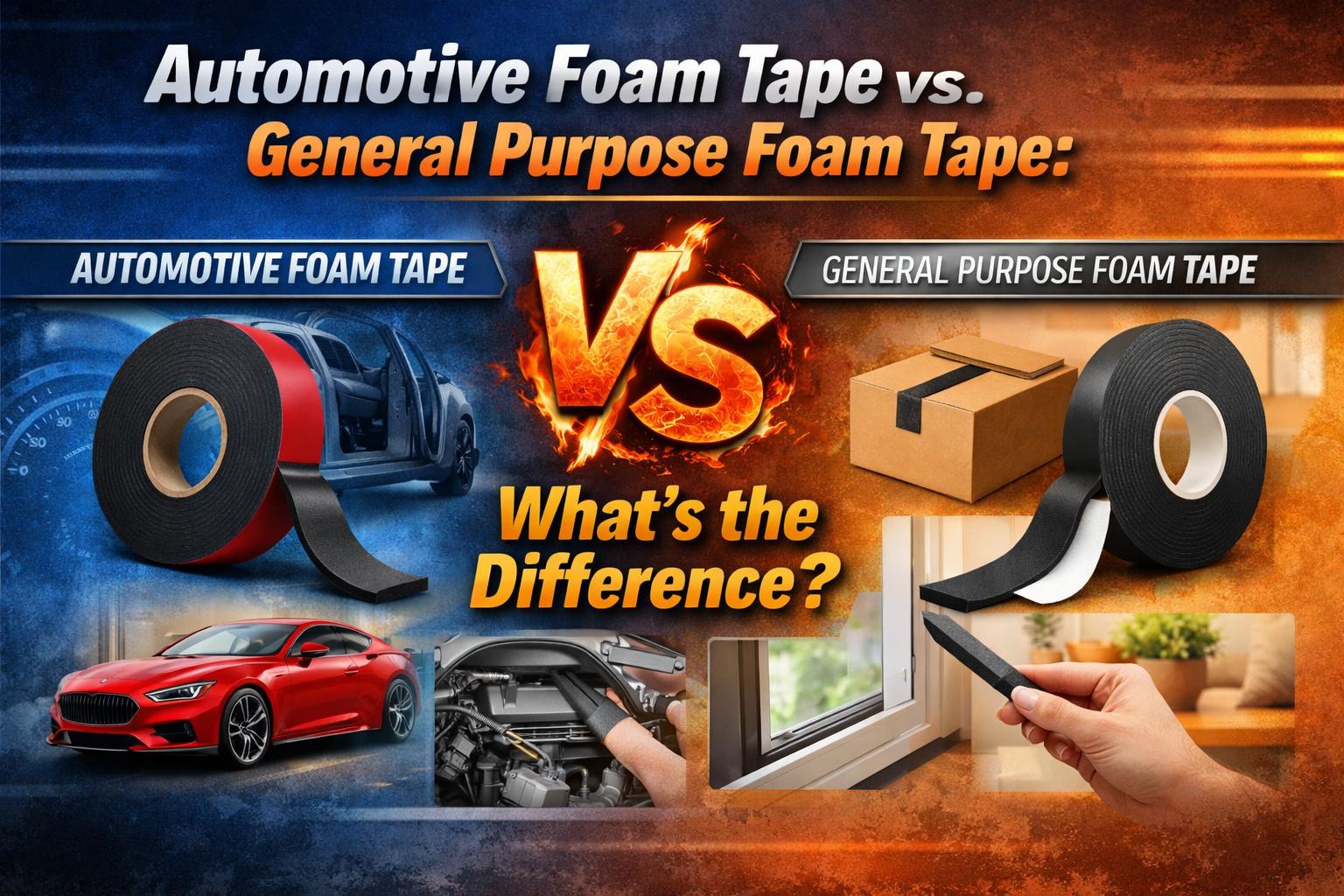
Automotive Foam Tape vs General Purpose Foam Tape: What’s the Difference?
It’s a question that comes up constantly in forums, Facebook groups, and DIY communities: “Can I just use normal double sided foam tape to stick a badge on my car?” or “Is there really a difference between automotive tape and the stuff from the DIY store?”
The short answer is yes — there’s a significant difference, and using the wrong tape on a vehicle exterior is one of the most common reasons badges fall off, trim strips peel away, and number plates end up on the motorway hard shoulder.
But the longer answer is more useful, because understanding why the tapes are different helps you choose the right product for every job — not just on cars, but for any application where you need to decide between automotive grade and general purpose foam tape.
The Mistake Most People Make
Walk into any DIY store or search “double sided foam tape” on Amazon, and you’ll find dozens of options from £2–£5. They all look similar — a roll of foam tape with adhesive on both sides, usually white or grey foam with a paper release liner. The packaging says “extra strong” or “heavy duty” and the description lists a dozen uses including “automotive”.
So people buy a roll, stick their badge or trim piece on, and it holds. For a while.
Then a few weeks later — sometimes a few months if they’re lucky — the badge starts lifting at the edges. The trim strip peels in hot weather. The number plate drops off after a car wash. And they’re back online, searching for a better tape or wondering what they did wrong.
What they did wrong was use a tape designed for hanging picture frames indoors on a surface that’s exposed to direct sunlight, rain, frost, road salt, car wash chemicals, vibration, and temperatures ranging from well below zero to scorching hot. It’s not that the tape was defective — it simply wasn’t built for the job.
The Three Things That Kill Standard Foam Tape Outdoors
General purpose foam tape works perfectly well for what it’s designed for — and we’ll get to that later in this post. But when it’s used on vehicle exteriors or any outdoor application, three specific environmental factors combine to destroy it.
1. UV Radiation
Sunlight is the single biggest enemy of rubber-based adhesives. The UV component of sunlight breaks down the polymer chains in the adhesive, causing it to harden, become brittle, and lose its tackiness. This process — called photo-oxidation — is irreversible and progressive. Once it starts, the adhesive gets weaker every day.
On a car parked outdoors, the bodywork absorbs hours of direct UV every day. South-facing panels — boot lids, rear bumpers, bonnets — get the worst of it. A badge mounted with standard rubber-adhesive tape on a south-facing boot lid might start lifting within 4–6 weeks in summer. By autumn, the adhesive has turned chalky and yellow, with almost no remaining grip.
Automotive grade foam tape uses an acrylic adhesive that’s specifically formulated to resist UV degradation. Acrylic adhesive maintains its flexibility, tack, and bonding strength even after years of direct sunlight exposure. This is why automotive tape holds badges and trim in place for the lifetime of the vehicle, while DIY tape fails within a single season.
2. Temperature Cycling
Every car goes through constant temperature changes. A vehicle parked in direct sun on a summer afternoon can see panel temperatures exceed 60–70°C. On a winter night, those same panels drop to -5°C or lower. Engine bays and areas near exhaust systems experience even greater extremes.
General purpose foam tape is typically rated for a temperature range of around 0°C to +50°C. That sounds reasonable — until you consider that a dark-coloured car bonnet in July easily exceeds 50°C, and a car parked outside in January regularly drops below 0°C. Outside its rated range, the rubber adhesive either softens and loses grip (in heat) or hardens and becomes brittle (in cold). Neither state holds a badge.
But it’s not just the extremes that cause problems — it’s the cycling between them. Every time the temperature rises and falls, the metal bodywork expands and contracts. This creates shear stress at the adhesive bond line, gradually fatiguing the tape. After hundreds of these cycles, even an adhesive that could technically handle the temperature range starts to delaminate.
Automotive foam tape is rated from -40°C to +150°C — comfortably covering every temperature condition a UK vehicle will ever encounter, including engine bay proximity and direct sun on dark paintwork. The acrylic adhesive is also engineered to absorb thermal cycling stress without fatigue, maintaining its bond integrity through thousands of expansion and contraction cycles.
3. Plasticisers
This is the one most people have never heard of — and it’s often the hidden cause of adhesive failure on cars.
Modern automotive paints, plastic bumpers, and polymer trim pieces all contain plasticisers — chemical compounds added during manufacturing to keep the materials flexible and prevent cracking. Over time, these plasticisers gradually migrate to the surface of the material, forming an invisible chemical film.
Rubber-based adhesives are highly susceptible to plasticiser attack. When the migrating plasticisers reach the adhesive bond line, they soften and break down the rubber compound, weakening the bond from the inside out. You can’t see this happening — from the outside, the tape looks fine — until one day the badge simply slides off, leaving a gummy, discoloured residue behind.
Acrylic adhesives are formulated to resist plasticiser migration. They maintain their chemical stability and bonding strength even in direct contact with plasticiser-rich automotive surfaces. This is one of the primary reasons the automotive industry specifies acrylic adhesive tapes for factory badge and trim bonding.
Rubber Adhesive vs Acrylic Adhesive: Side-by-Side
The adhesive type is the single most important difference between general purpose and automotive foam tape. Here’s how they compare across the properties that matter for vehicle and outdoor use.
| Property | Rubber Adhesive (General Purpose) | Acrylic Adhesive (Automotive Grade) |
|---|---|---|
| Initial tack | High — grips strongly on first contact | Moderate — builds to full strength over 12–24 hours |
| UV resistance | Poor — degrades within weeks of direct exposure | Excellent — maintains bond strength for years in direct sunlight |
| Temperature range | Approximately 0°C to +50°C | -40°C to +150°C |
| Temperature cycling | Fatigues and delaminates over repeated cycles | Absorbs thermal stress without bond degradation |
| Plasticiser resistance | Poor — softens and breaks down on contact | Excellent — chemically stable against plasticiser migration |
| Moisture resistance | Moderate — can weaken in sustained damp conditions | High — minimal performance loss in wet or humid environments |
| Chemical resistance | Low — vulnerable to solvents, fuels, and cleaning agents | High — resists common automotive fluids, car wash chemicals, and road salt |
| Long-term durability | Months (outdoor) / Years (indoor) | Years to decades in all environments |
| Cost | Lower | Higher |
| Best for | Indoor mounting, craft, signage, picture frames, temporary fixes | Vehicle exteriors, outdoor signage, industrial, any UV-exposed application |
One thing rubber adhesive does better than acrylic is initial tack — it grips more firmly on first contact. This is why general purpose tape feels strong when you first apply it. The badge or trim piece seems solidly attached, which gives people confidence that the tape is working. But that initial grab doesn’t predict long-term performance. Acrylic adhesive has lower initial tack but builds to a far stronger and more durable bond over 12–24 hours — and then maintains that bond for years.
This is an important distinction. If you test a piece of general purpose tape and a piece of automotive tape side by side on the day of application, the general purpose tape may actually feel stronger. It’s only over the following weeks and months that the performance gap becomes apparent — by which point your badge is already on the car and the rubber adhesive is quietly being destroyed by UV, heat, and plasticisers.
Closed-Cell vs Open-Cell Foam: Why the Carrier Matters Too
The adhesive gets most of the attention, but the foam carrier — the spongy layer in the middle of the tape — makes a significant difference to long-term performance as well.
Open-Cell Foam (General Purpose)
Most general purpose foam tapes use an open-cell foam carrier. Think of it like a kitchen sponge — the foam is made up of interconnected cells that can absorb and hold moisture. Indoors, this isn’t a problem. But on a car exterior, water from rain, condensation, and car washes gets drawn into the foam by capillary action. Once saturated, the water sits against the adhesive bond line, gradually weakening it. In winter, trapped moisture freezes and expands inside the foam cells, physically breaking down the cell structure. After a few freeze-thaw cycles, the foam becomes soft, crumbly, and structurally compromised.
Closed-Cell Foam (Automotive Grade)
Automotive foam tape uses a closed-cell polyethylene foam. Each cell is a sealed, individual pocket — like a microscopic balloon. Water can’t penetrate the cell structure, no matter how long the tape is exposed to rain, submersion, or pressure washing. The foam maintains its structural integrity, its thickness, and its cushioning properties throughout its entire service life.
Closed-cell foam also provides better vibration dampening than open-cell — the sealed cells act as miniature shock absorbers, cushioning the bond against the constant road vibration that all vehicle-mounted items experience. This is why automotive tape prevents the rattles and buzzes that can occur when rigid badges and trim pieces are bonded directly to body panels.
Real-World Failure Scenarios
To make this concrete, here are the failure patterns we see most often when general purpose foam tape is used on vehicles.
The summer badge drop. A driver reattaches a boot lid badge in April using general purpose tape from a hardware store. It holds through spring. By mid-June, after several weeks of direct sun, the rubber adhesive has softened and lost tack. The badge starts lifting at the edges. On a hot July afternoon, after the car’s been parked in full sun all day, the badge slides off onto the ground. Panel temperature: 65°C. Tape’s rated maximum: 50°C.
The winter trim peel. A body side moulding is refitted with general purpose tape in September. It holds through autumn. In December, overnight temperatures drop below zero. The rubber adhesive hardens and becomes brittle. The thermal contraction of the body panel creates shear stress that the rigid, cold-hardened adhesive can’t absorb. One cold morning, the trim strip is hanging off the car by one end.
The car wash catastrophe. Number plates are mounted with cheap foam tape. The tape holds for a few months, but the open-cell foam has been gradually absorbing moisture from rain and condensation. On a visit to an automatic car wash, the high-pressure pre-wash jets drive water behind the already-weakened adhesive. The spinning brushes catch the lifted edge of the plate. The driver emerges from the car wash with one plate missing and a strip of gummy residue on the bumper.
The mystery residue. A chrome trim strip was fitted with general purpose tape two years ago. The strip has held — just about — but the rubber adhesive has been slowly degraded by plasticiser migration from the painted body panel. When the strip is removed for a respray, the adhesive has turned into a dark, sticky mess that takes hours to clean off, requiring clay bar, adhesive remover, and careful polishing to avoid damaging the paint underneath.
Every one of these scenarios is avoided by using automotive grade tape from the outset. The acrylic adhesive handles the UV, the temperature extremes, the plasticisers, and the moisture. The closed-cell foam shrugs off water ingress and freeze-thaw cycling. The badge, trim, or plate stays put — not just for months, but for years.
When General Purpose Foam Tape Is Perfectly Fine
Having spent most of this post explaining why general purpose foam tape doesn’t work on cars, it’s worth being clear about where it does work — because it’s a perfectly good product for a very wide range of applications.
General purpose high grab foam tape is the right choice for:
Indoor mounting and fixing. Picture frames, mirrors, hooks, shelving brackets, signs, smoke detectors, cable clips, decorative items — any indoor application on a smooth, clean surface. Without UV exposure, temperature extremes, or moisture, the rubber adhesive provides a strong, long-lasting bond at a lower cost than automotive grade tape.
Point of sale and retail displays. Mounting POS materials, signage, display boards, and promotional elements to walls, stands, and fixtures in indoor retail environments.
Craft and model making. Securing components that need to be adjustable, removable, or repositioned — scrapbooking, model building, prototyping, and educational projects.
Temporary outdoor fixes. If you need a short-term hold on a vehicle — keeping a badge in place while you wait for the right tape to arrive, securing a loose trim piece for a journey to the garage, or a temporary repair that you know you’ll redo properly within a few days — general purpose tape will hold long enough to get you through.
Industrial and commercial indoor use. Bonding panels, signs, insulation, and components in indoor commercial environments — offices, warehouses, factories, and workshops — where the tape isn’t exposed to UV or weather.
The critical distinction is indoor vs outdoor and short-term vs permanent. Inside, away from UV and temperature extremes, general purpose tape performs well for years. Outside — on vehicles or any weather-exposed surface — it doesn’t.
Quick Decision Guide
| Question | If Yes → | If No → |
|---|---|---|
| Is the item going on the exterior of a vehicle? | Automotive foam tape | See below |
| Is it going outdoors and exposed to direct sunlight? | Automotive foam tape | See below |
| Does it need to withstand temperatures above 50°C or below 0°C? | Automotive foam tape | See below |
| Will it be exposed to rain, car washes, or high humidity long-term? | Automotive foam tape | See below |
| Is the surface a painted automotive panel or plastic bumper? | Automotive foam tape | See below |
| Is it an indoor application on a smooth surface? | General purpose high grab foam tape | Contact us for advice |
| Is it a temporary fix that will be redone within days? | General purpose high grab foam tape | Contact us for advice |
If you’re still not sure which tape is right for your application, contact our product support team. We’ll recommend the right product based on your specific surface, environment, and requirements — no charge, no obligation.
Frequently Asked Questions
Can I use normal double sided tape on my car?
For interior applications — mounting a phone holder, securing a dashcam, tidying cables — general purpose tape can work, though it may soften in a hot car on sunny days. For anything on the exterior of the vehicle, always use automotive grade foam tape. Standard tape will fail within weeks to months when exposed to UV, temperature extremes, and moisture.
Why does automotive tape cost more?
The acrylic adhesive used in automotive tape is more expensive to manufacture than rubber adhesive. It requires a different chemical formulation, different coating process, and higher-grade raw materials to achieve the UV resistance, temperature stability, and plasticiser resistance that vehicle applications demand. The closed-cell polyethylene foam carrier is also a more costly material than the open-cell foam used in general purpose tapes. However, the cost difference per metre is relatively small — and it’s considerably cheaper than reattaching a badge multiple times or dealing with adhesive residue damage from degraded tape.
Is automotive tape also better for outdoor signage?
Yes. Any outdoor application where the tape is exposed to direct sunlight, rain, and temperature swings will benefit from automotive grade tape. Outdoor signage, exterior building fixtures, garden accessories, marine applications, and external equipment housings all fall into this category.
I used general purpose tape and it’s holding fine — should I worry?
If it’s been less than a few months, the tape may still be within its initial performance window. Rubber adhesive doesn’t fail instantly — it degrades gradually. If the tape has been in place for over a year in a UV-exposed position and is still holding well, it may be a higher-quality rubber formulation. But if you’re seeing any signs of lifting at the edges, yellowing of the adhesive, or softening in warm weather, it’s worth replacing with automotive tape before the bond fails completely.
Can I use automotive tape indoors?
Absolutely — automotive tape works perfectly indoors. It’s simply over-specified for most indoor applications. If you already have a roll of automotive tape and need to mount something inside, there’s no downside to using it. You’ll just be paying slightly more per metre than you would with general purpose tape for a level of UV and weather resistance you don’t need.
The Right Tape for Every Job
We stock both types of foam tape, because both have their place.
For vehicle exteriors, outdoor signage, and weather-exposed applications: our automotive double sided foam tape range is available in widths from 6mm to 50mm on 50-metre rolls, with bulk discounts on every size.
For indoor mounting, POS, craft, and general purpose use: our high grab double sided foam tape range covers a wide range of widths and thicknesses for domestic, commercial, and industrial applications.
Every roll ships from our Leicester warehouse within 2–3 working days, with free mainland UK delivery on orders over £60 and next day delivery available on orders placed before 12pm.



Add comment