
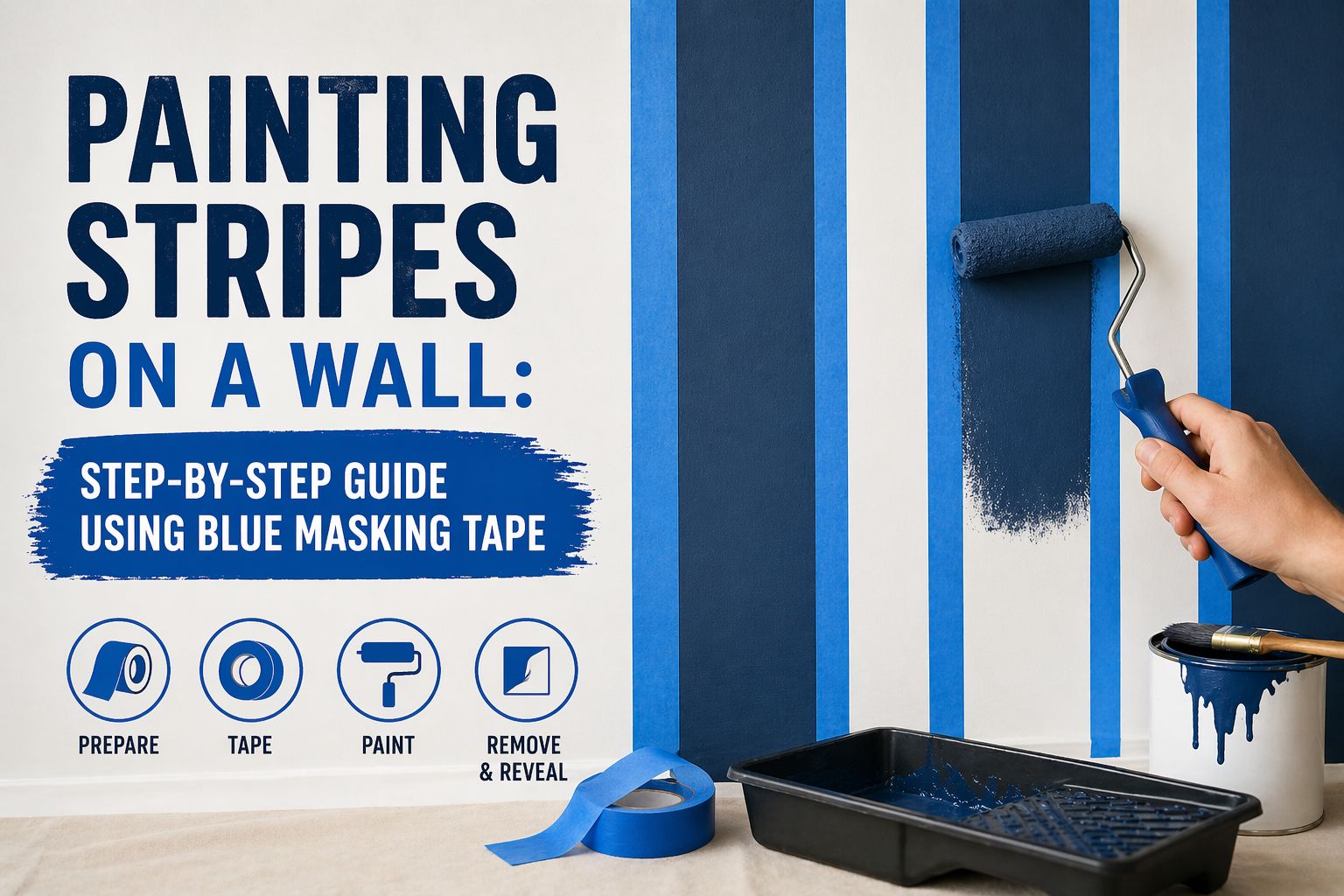
Painting Stripes on a Wall: Step-by-Step Guide Using Blue Masking Tape
A striped feature wall is one of those projects that looks more difficult than it actually is. Done well, it transforms a room — adding height to a nursery, warmth to a bedroom, or a bit of personality to an otherwise flat hallway. Done badly, it looks like a paint roller had an accident.
The difference almost always comes down to one thing: the tape, and how you use it.
This guide walks you through phow to paint stripes on a wall from start to finish — planning, measuring, taping, and the little tricks that separate a sharp, professional finish from a wavy, paint-bleeding mess.
Before You Start: Planning Your Stripes
A bit of thinking up front saves hours of frustration later. Before you buy anything, decide:
1. Vertical or horizontal? Vertical stripes make a room feel taller — great for rooms with low ceilings. Horizontal stripes make a room feel wider and more spacious — good for narrow spaces like hallways or small bedrooms.
2. How wide should the stripes be? Wider stripes (20–30cm) feel modern and calm. Narrower stripes (5–10cm) feel more traditional or playful — perfect for nurseries and children’s rooms. A mix of widths can also look striking if you’re feeling confident.
3. How many colours? Two-colour stripes are the classic choice and easiest to pull off. Tone-on-tone (same colour, one matt and one satin finish) creates a subtle, sophisticated look that photographs beautifully. More than two colours gets tricky fast — start simple.
4. Where do the stripes end? Full height? Stopping at a picture rail? Ending halfway down for a half-striped wall? Decide this before you tape, not while you’re holding a roller.
What You’ll Need
- Paint in your chosen colours (plus your base coat if the wall isn’t already painted)
- Blue painter’s tape — 19mm or 25mm width works for most jobs. For wider stripes or floor-to-ceiling lines, 50mm gives you more forgiveness
- Tape measure and pencil
- Spirit level (essential — do not skip this)
- A step ladder if your stripes go higher than you can comfortably reach
- A small paintbrush and a mini roller
- A plastic spreader or an old credit card (for sealing the tape edge — more on this below)
- Dust sheet and a damp cloth
For the tape, we’d point you towards our 14-day blue painter’s tape range — it’s low-tack enough to come off cleanly, visible against most wall colours so you can check your work, and gives you two weeks to complete the job if life gets in the way.
Step 1: Paint Your Base Colour First
This is the step most people want to skip, and it’s the one that makes or breaks the whole project.
Paint the entire wall in your lighter colour first (or whichever colour will be the “background” of your stripes). Let it dry for a full 24 hours — ideally 48 — before you even think about taping.
Why? Two reasons:
- The tape needs to stick to a fully cured surface. Tape applied to tacky paint will either not stick properly or will lift the paint when you remove it.
- You’re about to use a clever trick in Step 5 that relies on the base coat being dry and solid.
Step 2: Measure and Mark Your Stripes
Grab your tape measure, pencil, and spirit level.
For vertical stripes: Measure along the top of the wall and mark where each stripe begins and ends. Do the same along the bottom of the wall. Then use your spirit level to draw a light pencil line connecting each pair of marks top-to-bottom. Do not skip the spirit level — even a slightly wonky stripe is the first thing the eye will notice.
For horizontal stripes: Measure the total height of the wall and divide by the number of stripes you want. If you want stripes of equal width, the maths is simple. If you want a varied pattern, sketch it on paper first. Mark the top and bottom of each stripe on both the left and right edges of the wall, then use your spirit level to draw the horizontal pencil lines.
Pro tip: Measure twice, mark once. It’s much easier to rub out a pencil line than to repaint a stripe.
Step 3: Apply the Blue Masking Tape
Here’s where the choice of tape really matters. You want a tape that will:
- Peel off cleanly without pulling up your base coat
- Resist paint bleed along the edge
- Stay put long enough for the paint to fully dry
A quality blue painter’s tape handles all three. A cheap general-purpose masking tape — the cream kind — will let you down on at least one, usually all three. We’ve covered the full breakdown in our blue tape vs cream masking tape comparison if you want the detail.
How to apply the tape:
Apply the tape on the side of the pencil line that will not be painted. So if you’re painting a stripe between two pencil lines, the tape goes on the outside of each line.
Press the tape down firmly as you go, working in sections of about a metre at a time. Don’t stretch it — just lay it flat against the wall. For long vertical runs, start at the top and work down, keeping slight tension so the tape stays straight.
If you need to join pieces of tape, overlap them by about a centimetre rather than butting them end-to-end.
Step 4: Seal the Tape Edge (The Most Important Step)
This is the trick the pros use and most DIY tutorials skip. It’s the single biggest factor in getting razor-sharp lines.
Once your tape is in place, run a plastic spreader (or the edge of an old credit card) firmly along the edge of the tape — the edge where the paint will go. You’re pressing the tape flat and sealing any tiny gaps between the tape and the wall. This is where paint would otherwise seep under.
Don’t press so hard that you stretch or tear the tape. Firm, steady pressure along the full length of every stripe is all you need.
Step 5: Paint Your Base Colour Over the Tape Edge
Yes — you read that right. Before you apply your stripe colour, paint a thin layer of your base colour along the edge of each piece of tape.
This sounds counterintuitive, but it’s the single best trick for getting sharp lines. Here’s why: if any paint is going to bleed under the tape, it’s going to happen on this coat. And because this coat is the same colour as the wall underneath, any bleed becomes completely invisible. It also seals the tape edge even more thoroughly.
Let this coat dry for an hour or two before moving on.
Step 6: Paint Your Stripe Colour
Now, finally, apply your stripe colour. Two thin coats are almost always better than one thick one — thick coats are more likely to bleed under tape, drip, and dry unevenly.
Use a small roller for the bulk of the stripe and a brush to cut in near the tape edges. Let each coat dry according to the paint manufacturer’s instructions before applying the next.
Don’t worry if you get paint on the tape itself — that’s exactly what the tape is there for.
Step 7: Remove the Tape at the Right Moment
Timing matters here. You want to remove the tape:
- Before the paint fully cures and bonds the tape to the wall (within 1–2 hours of the final coat is ideal)
- But after the paint has stopped being wet to the touch
If you remove the tape too early, wet paint can run. Too late, and the dried paint film can tear along the tape edge and leave a rough line.
How to remove it: Pull the tape back on itself at a 45-degree angle, slowly and steadily. Never yank it straight up or outward.
If you notice any paint trying to lift with the tape, stop and score along the edge of the tape with a craft knife to separate the paint film before continuing.
Step 8: Touch Up and Admire
Once the tape is off, stand back and have a look. Most jobs will need a tiny bit of touching up — a fine brush and a steady hand is all you need for any small imperfections.
Then step back, admire your handiwork, and try not to photograph every wall you own from now on.
Common Mistakes to Avoid
A few quick things that trip people up:
- Skipping the spirit level — trust us, your eye is not as accurate as you think.
- Using cheap masking tape to save money — it isn’t worth the hours of touch-ups.
- Painting directly over the tape with the stripe colour first — always do the base-colour seal coat in Step 5.
- Leaving the tape on overnight after painting — the longer it stays, the harder it is to remove cleanly.
- Rushing the base coat drying time — 24 hours minimum.
Ready to Start?
Striped walls are one of the most satisfying DIY projects there is — relatively quick, genuinely transformative, and completely customisable to your space.
The tape does a lot of the heavy lifting, so it’s worth using one that’s actually designed for the job. Have a browse of our blue painter’s tape range or the full decorators’ tape collection if you want to explore specialist options like delicate surface tapes (ideal for freshly painted nursery walls) or fine line tapes (for precision work).
Need a hand choosing the right tape for your project? Give our sales team a call on 0116 286 5141 or email [email protected] — we’re always happy to help.

Add comment