
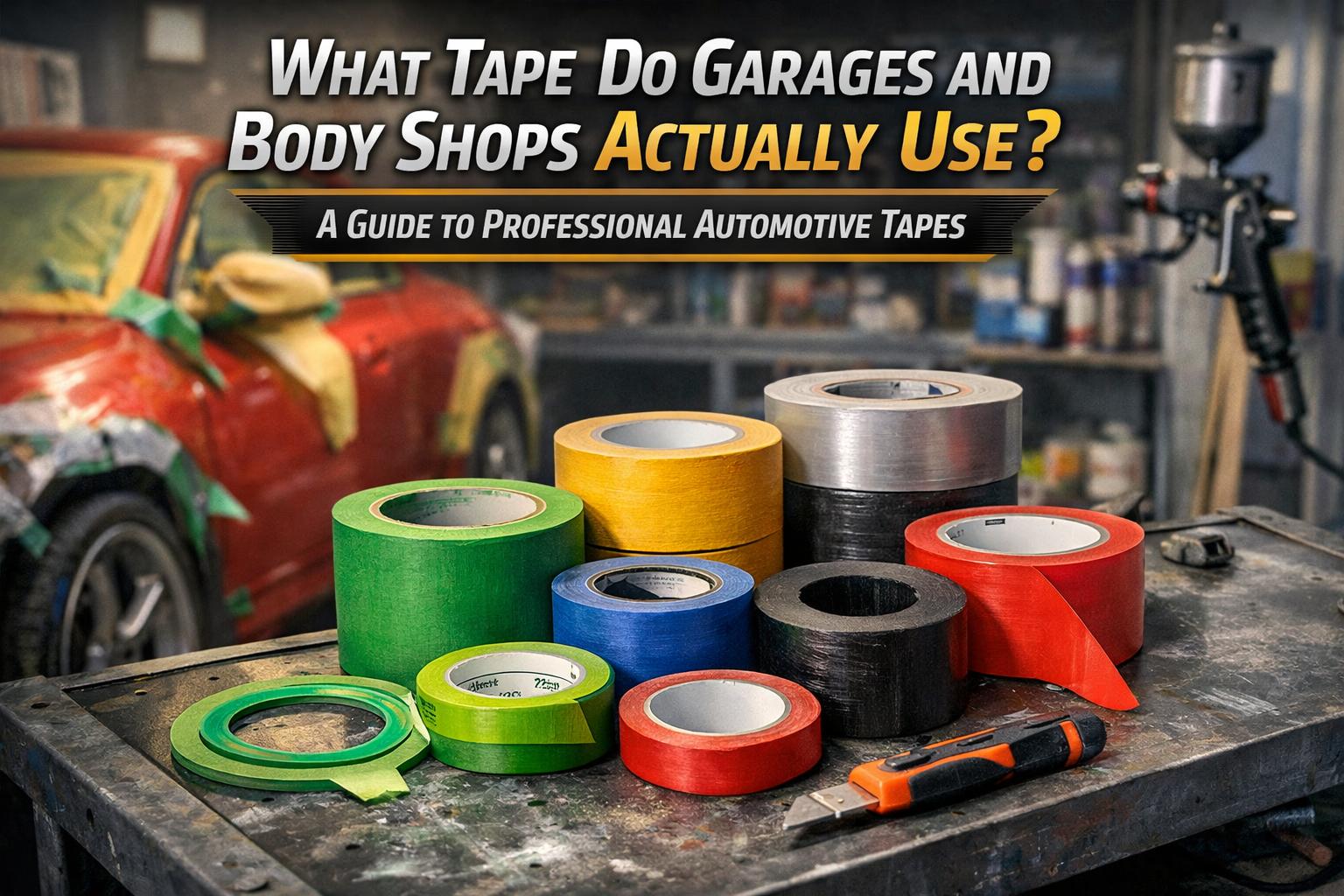
Walk into any professional body shop, garage workshop, or vehicle restoration business and you’ll find a surprising number of different tapes. Not just one or two rolls on a shelf — but an entire arsenal of specialist tapes, each designed for a specific job.
For most car owners, “automotive tape” means one thing: the double sided tape that holds badges on. But for professionals, tape is one of the most versatile and frequently used consumables in the workshop. Different tapes for painting, for wiring, for heat protection, for trim mounting, for temporary repairs, and for panel bonding — each formulated with specific adhesive chemistry, carrier materials, and performance characteristics for its particular role.
This guide cuts through the confusion. Here’s what professional garages and body shops actually stock, what each tape is designed for, and how to choose the right one for your application — whether you’re running a busy workshop or tackling a weekend project in your own garage.
1. Automotive Double Sided Foam Tape
What it is: Closed-cell polyethylene foam with solvent-based acrylic adhesive on both sides.
What professionals use it for: This is the industry-standard tape for permanent exterior bonding. Body shops reach for it whenever they need to mount or remount something to the outside of a vehicle — car badges after a respray, replacement trim strips, number plates, chrome accents, rain deflectors, and body side mouldings. It’s also used for fitting aftermarket accessories like parking sensors, camera housings, and decorative elements.
Why this specific tape: The acrylic adhesive is the key. Unlike rubber adhesive (found on general purpose foam tape), acrylic resists UV degradation, handles temperatures from -40°C to +150°C, and is impervious to the plasticisers that migrate from automotive paints and plastics. The closed-cell foam carrier doesn’t absorb water, dampens road vibration, and provides a compliant layer that compensates for slight surface irregularities between the badge and the bodywork.
Professional body shops won’t use general purpose foam tape on vehicle exteriors — they’ve seen too many callbacks from badges and trim falling off after a few months. Automotive grade tape costs marginally more per metre but eliminates warranty claims and rework.
Available in our range: Automotive double sided foam tape in five widths — 6mm for small badges and fine trim, 12mm for standard emblems and mouldings, 19mm for number plates and wider trim, 25mm for large body strips and wheel arch trims, and 50mm for body kit components and heavy panels. All supplied on 50-metre rolls with bulk discounts.
Further reading: Our guide on how to fit aftermarket trim, mouldings and chrome strips covers the full application process for this tape, including surface preparation, alignment techniques, and cold weather advice.
2. High-Temperature Automotive Masking Tape
What it is: Crepe paper masking tape with a rubber-based adhesive, engineered for automotive spray painting in high-temperature environments.
What professionals use it for: This is the tape that body shops and spray booths use every single day. It masks off areas of the vehicle that shouldn’t be painted — window glass, rubber seals, trim pieces, badges, lights, and adjacent panels — during primer, base coat, and clear coat application. It’s also used to hold masking paper and masking film in place over larger areas.
The critical requirement is that the tape must withstand the temperatures inside a spray booth during paint curing (typically 60–120°C) without shrinking, lifting, melting, or leaving adhesive residue on the freshly painted surface. Standard masking tape from a decorating supplies shop can’t handle this — it’ll bake onto the panel and leave a sticky mess that requires hours of remediation.
Why this specific tape: Automotive masking tape is rated to withstand temperatures up to 110°C for sustained periods (up to 60 minutes) and can handle short bursts of 120°C. It conforms easily to curves and contours — essential when masking around wheel arches, bumper edges, and window frames — and tears cleanly by hand without fraying. Crucially, it removes cleanly after baking, leaving sharp paint lines with no adhesive residue.
Available in our range: We stock high-temperature automotive masking tape in multiple widths — 19mm, 24mm, 36mm, and 48mm — all on 50-metre rolls. Body shops typically stock at least two widths: a narrow tape (19mm or 24mm) for detail work and edges, and a wider tape (36mm or 48mm) for covering larger areas and holding down masking paper.
3. Fine Line Masking Tape
What it is: A thin, flexible PVC or vinyl masking tape designed for precision paint masking with extremely sharp paint edges.
What professionals use it for: Fine line tape is the specialist tool for creating perfectly crisp, razor-sharp boundaries between two paint colours. It’s used for two-tone paint jobs, custom stripe work, multi-colour bumper masking, and any application where the paint edge needs to be flawless. It’s also essential for masking complex curves and contours where standard crepe paper masking tape would wrinkle and allow paint to bleed underneath.
In a professional body shop, fine line tape is used alongside standard masking tape — the fine line tape creates the precise edge, then wider masking tape and paper are used to cover the surrounding area.
Why this specific tape: Fine line tape is thinner and more flexible than standard masking tape, so it stretches around tight curves without lifting or wrinkling. The adhesive is formulated for clean removal without residue, even after exposure to UV and heat. The tape edge is engineered to prevent paint creep, producing a paint line so sharp it looks like it was applied with a ruler.
Available in our range: Fine line masking tape starting from 6mm width — ideal for pinstripes, custom detailing, and precision multi-colour work.
4. Heat Reflection Tape
What it is: An aluminium-faced tape with heat-reflective properties, designed to shield components from radiant heat.
What professionals use it for: Heat reflection tape is wrapped around or applied to wiring looms, fuel lines, brake hoses, and other heat-sensitive components that run near exhaust manifolds, turbochargers, or catalytic converters. By reflecting radiant heat away from these components, the tape prevents insulation damage, premature hose degradation, and potential safety hazards from heat-damaged wiring or fuel lines.
It’s a standard part of engine bay work in performance garages, motorsport workshops, and any shop working on turbocharged or modified vehicles where under-bonnet temperatures are significantly elevated.
Why this specific tape: The Coroplast 1238x heat reflection tape in our range has been tested to 3,000 hours at 125°C, with short-term resistance measured at 240 hours at 175°C. This level of heat tolerance is far beyond what any standard tape can offer, making it the go-to product for protecting components in the most thermally demanding areas of a vehicle.
Available in our range: Coroplast 1238x heat reflection tape is stocked within our harnessing tapes category. Contact us for specific width and quantity requirements.
5. Cable Harnessing and Wire Bundling Tape
What it is: A PET (polyethylene terephthalate) coated cloth tape designed specifically for bundling and protecting automotive wiring.
What professionals use it for: Every vehicle contains hundreds of metres of electrical wiring, organised into harnesses and looms that route power and signals around the car. When garages and body shops need to add, repair, or reroute wiring — for aftermarket accessories, fault repairs, alarm installations, or restoration work — they use harnessing tape to bundle the new wiring neatly and protect it from abrasion, heat, and moisture.
Harnessing tape is also used during vehicle manufacturing. The Coroplast wire harness tapes in our range are officially approved for use on BMW, Daimler, Fiat, Ford, Vauxhall/Opel, General Motors, Mazda, Nissan, Renault, and Volkswagen production lines — so when you use this tape on an aftermarket wiring job, you’re using the same product that was used to build the car in the first place.
Why this specific tape: Automotive harnessing tape is resistant to high and low temperatures, motor vehicle operating fluids (diesel, petrol, coolant, brake fluid), and abrasion from vibration and routing through tight spaces. It conforms tightly around wire bundles, stays put without unwinding, and provides a factory-finish appearance that’s indistinguishable from OEM harnesses.
Available in our range: Our harnessing tapes category includes Coroplast PET bundling tape (837x) for cable and wire set bundling, and Coroplast wire harness tape (8551x) for neat, professional harnessing. Both are used by OEM manufacturers worldwide.
6. Cloth Tape and Gaffer Tape
What it is: A cloth-backed pressure sensitive tape with a strong rubber adhesive. Available in various weights from economy to heavy-duty.
What professionals use it for: Cloth tape — often called gaffer tape or duct tape depending on the grade — is the Swiss army knife of the workshop. Garages and body shops use it for temporary repairs during stripdowns, bundling components during disassembly, masking off large areas during blasting or etching, sealing duct joints on HVAC systems, and a hundred other quick-fix and holding applications.
In motorsport, cloth tape is known as “tank tape” and is used to secure bodywork, cover headlights during rally stages, and make rapid repairs between stages. Its strength, tearability, and ability to stick to dirty or irregular surfaces make it the tape of choice when speed matters more than permanence.
Why this specific tape: Cloth tape combines high tensile strength with hand-tearability — you can rip it to length without scissors, yet it’s strong enough to bundle heavy components and resist pulling forces. The rubber adhesive provides aggressive immediate grip on almost any surface, including metal, plastic, rubber, wood, and even slightly dirty or oily substrates.
Available in our range: We stock a wide range of cloth, gaffer, and duct tapes including matte black gaffer tape for non-reflective workshop use, heavy-duty gaffer tape for demanding structural and repair applications, and coloured waterproof cloth tape for identification, colour-coding, and marking.
7. Self-Amalgamating Tape
What it is: A non-adhesive rubber tape that bonds to itself when stretched and wrapped, forming a solid, waterproof, insulating mass.
What professionals use it for: Self-amalgamating tape is unique among automotive tapes because it doesn’t use adhesive at all. Instead, when you stretch the tape and wrap it around a pipe, hose, or cable joint, the layers fuse together into a single solid rubber mass. This creates a completely watertight, airtight, and electrically insulating seal.
In automotive workshops, it’s used for emergency repairs to radiator hoses and coolant lines, sealing electrical joints and connections in the engine bay, protecting exposed wiring from moisture and corrosion, and temporary pipe repairs to get a vehicle off the road and into the workshop. It’s also widely used in marine, plumbing, and caravan applications for the same reasons.
Why this specific tape: Self-amalgamating tape creates a permanent, solid rubber seal that won’t unwrap, won’t be affected by heat or vibration, and can withstand pressure from within the pipe or hose. Unlike adhesive tapes that sit on the surface, self-amalgamating tape physically becomes part of the repair — making it significantly more reliable for pressure-bearing applications.
Available in our range: Our self-amalgamating polyisobutylene tape is stocked within the car tapes category. It’s also popular with our boat building and marine customers for waterproof sealing applications.
8. PVC Electrical Insulation Tape
What it is: A flexible polyvinyl chloride (PVC) tape with a synthetic rubber adhesive, conforming to BS3924 for electrical insulation.
What professionals use it for: PVC tape is used to insulate electrical connections, wrap exposed wiring, colour-code circuits, and protect wire terminations from moisture and short circuits. Every automotive electrician, alarm fitter, and audio installer goes through rolls of PVC tape daily.
It’s also used for non-electrical applications where a flexible, conformable, self-extinguishing tape is needed — wrapping cables, masking during chemical plating processes, retaining protective pads, and general colour-coding in the workshop.
Why this specific tape: Flame retardancy is the critical property. Automotive PVC tape conforms to BS3924, meaning it self-extinguishes rather than sustaining a flame. In a vehicle’s wiring system — where a short circuit near fuel lines or insulation could have serious consequences — this property isn’t optional. The tape is also highly flexible, conforms to irregular shapes, and provides good dielectric strength for electrical insulation.
Available in our range: PVC electrical insulation tape is available in our PVC tape category in multiple colours for circuit identification and coding.
9. Spray Adhesive and Contact Adhesive
What it is: Aerosol or canister-based adhesive that bonds on contact, designed for large surface area applications.
What professionals use it for: Spray adhesive is the go-to product for bonding large, flat, flexible materials to vehicle interiors and structures. The most common body shop application is headliner bonding — when a vehicle’s roof lining sags (a near-universal problem on older cars), the old adhesive is cleaned off and spray adhesive is used to re-bond the fabric to the headliner board.
Other applications include bonding carpet and floor coverings to vehicle floors, attaching sound deadening and insulation mats to doors, floors, and wheel arches, securing boot linings and parcel shelf coverings, and laminating trim panels during upholstery repairs.
Why spray rather than tape: Spray adhesive covers large areas quickly and evenly — far faster than cutting and applying strips of double sided tape across an entire headliner or floor. It also bonds porous materials (fabric, foam, carpet) that tape adhesives struggle with, because the spray soaks into the material fibres rather than sitting on the surface.
Available in our range: We stock automotive spray adhesives and spray glues within the car tapes and automotive adhesives category, ranging from 500ml aerosol cans for small jobs to 22-litre commercial canisters for busy workshops. Contact us for advice on the right spray adhesive for your application.
Quick Reference: Application → Tape
| Application | Tape Type | Where to Find It |
|---|---|---|
| Car badges, emblems, nameplates | Automotive double sided foam tape | Automotive foam tape range |
| Number plates | Automotive double sided foam tape (19mm or 25mm) | 19mm / 25mm |
| Trim strips, mouldings, chrome | Automotive double sided foam tape | Automotive foam tape range |
| Spray painting / respray masking | High-temperature masking tape | Masking tape range |
| Two-tone paint, custom stripes | Fine line masking tape | Fine line tape |
| Protecting wiring from engine heat | Heat reflection tape (Coroplast 1238x) | Harnessing tapes |
| Bundling and routing wiring | Cable harnessing tape (Coroplast 837x / 8551x) | Harnessing tapes |
| Temporary repairs, bundling, workshop use | Cloth / gaffer tape | Cloth & gaffer tapes |
| Hose and pipe emergency repair | Self-amalgamating tape | Car tapes |
| Electrical insulation, wire wrapping | PVC insulation tape | PVC tape |
| Headliners, carpet, sound deadening | Spray adhesive | Car tapes & adhesives |
Building Your Workshop Tape Kit
If you’re setting up a workshop or restocking your supplies, here’s what a well-equipped garage typically keeps on hand.
Essential (every workshop needs these):
- Automotive double sided foam tape in at least two widths (12mm for badges, 19mm or 25mm for trim and plates)
- High-temperature masking tape in two widths (24mm and 48mm)
- Heavy-duty gaffer tape
- PVC electrical insulation tape in black plus two or three colours
Recommended (for body shops and paint facilities):
- Everything above, plus:
- Fine line masking tape for precision paint work
- Wider masking tape sizes for covering large panels
- Spray adhesive for headliner and upholstery work
Specialist (for performance, restoration, and electrical work):
- Everything above, plus:
- Heat reflection tape for engine bay protection
- Harnessing tape for professional wiring work
- Self-amalgamating tape for pipe and hose repairs
- 6mm foam tape and 50mm foam tape for fine detail work and large panel mounting
Frequently Asked Questions
Can I use household masking tape for spray painting a car?
Household masking tape is designed for interior decorating at room temperature. In a spray booth environment, where temperatures during paint curing can reach 60–120°C, household tape will shrink, lift at the edges, and leave adhesive residue baked onto the paintwork. Always use high-temperature automotive masking tape rated for at least 110°C.
What’s the difference between gaffer tape and duct tape?
They look similar but serve different purposes. Duct tape has a polyethylene-coated cloth backing with a very aggressive adhesive — it’s extremely strong but difficult to remove cleanly. Gaffer tape has a matte cloth backing with a less aggressive adhesive that removes without residue. In a workshop, gaffer tape is generally preferred because it won’t leave a sticky mess on panels and components. For a full comparison, see our blog post on duct tape vs gaffer tape.
Do professionals use acrylic foam tape instead of carrier-based foam tape?
Professionals select tape for the materials, environment, and loading. Acrylic foam tapes and closed-cell polyethylene foam tapes with acrylic adhesive are used for different automotive bonding applications. Follow the chosen product’s specification and application guidance.
Is there one tape that does everything on a car?
No — and that’s exactly why professional workshops stock multiple types. Each tape in this guide is engineered for a specific set of conditions and applications. Using the wrong tape for the job (masking tape for trim mounting, foam tape for electrical insulation, gaffer tape for permanent badge bonding) will give you a poor result and often a failure. The right tape for the right job is the fundamental principle of professional work.
Where can I buy professional automotive tape in small quantities?
All the tapes mentioned in this guide are available from PSA Solutions in individual rolls — you don’t need to buy in trade quantities to access professional-grade products. Every roll comes with bulk discounts if you do need larger quantities, and orders over £60 ship free to mainland UK.
Shop the Full Automotive Tape Range
Everything in this guide is available from our Leicester warehouse, dispatched within 2–3 working days with free mainland UK delivery on orders over £60 and next day delivery available on orders placed before 12pm.
Browse the full car tapes and automotive adhesives range, or jump directly to the category you need:
- Automotive double sided foam tape
- Harnessing and heat reflection tapes
- Cloth, gaffer, and duct tapes
- PVC electrical tape
Not sure which tape you need? Contact our team — we’ll recommend the right product for your application. Call us on 0116 286 5141 or email [email protected].


Add comment