
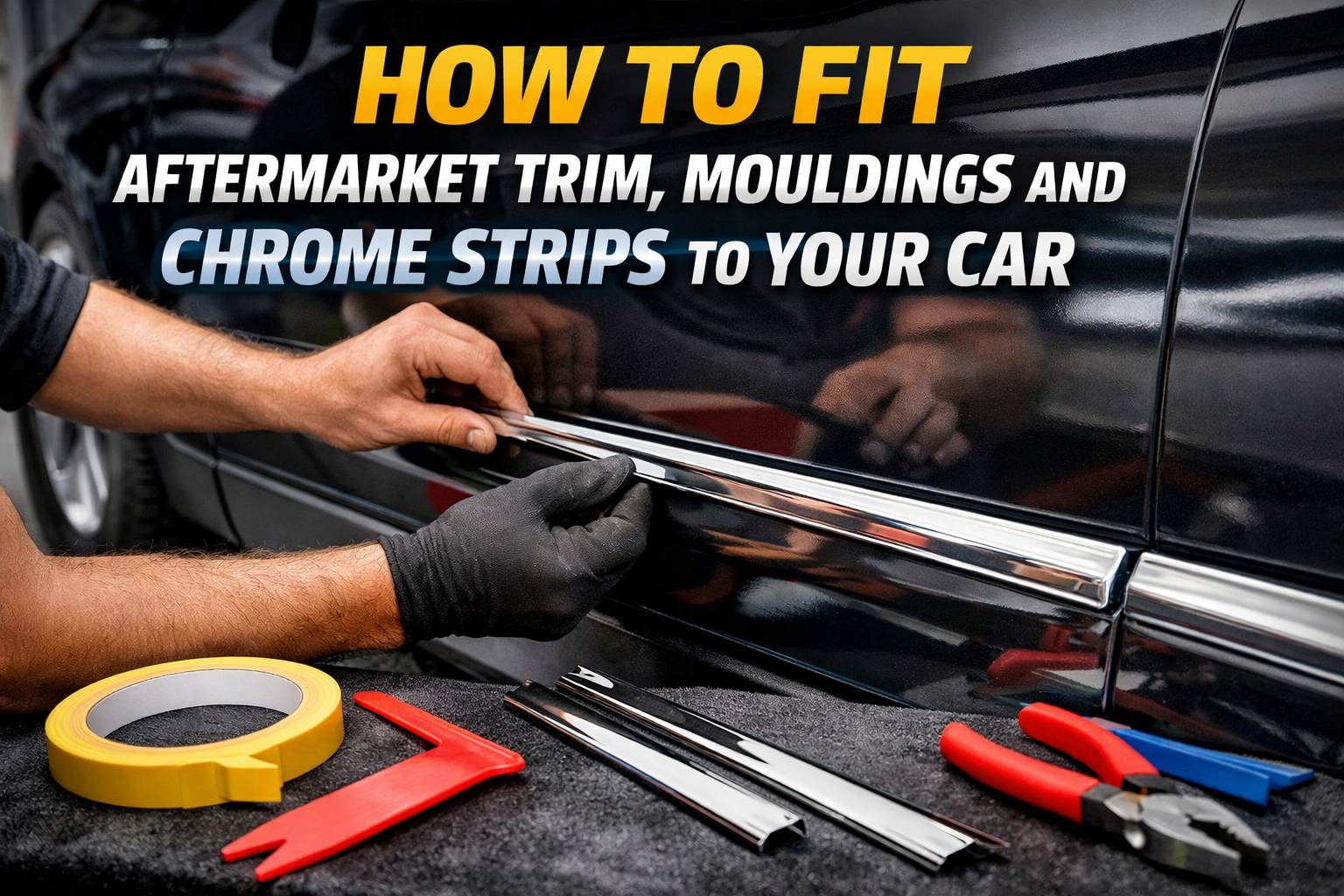
How to Fit Aftermarket Trim, Mouldings and Chrome Strips to Your Car
Fitting aftermarket trim is one of the most satisfying jobs you can do on a car. A new set of chrome strips, a fresh body side moulding, or a set of door edge protectors can transform the look of a vehicle in an afternoon — and the only tool you really need is the right tape.
But getting a professional result depends on three things: choosing the correct tape width for the trim you’re fitting, preparing the surface properly, and getting the alignment right before you commit. Rush any of these and you’ll end up with trim that’s crooked, peeling at the edges, or falling off entirely within a few months.
This guide covers the full process from start to finish — what trim types are available, which tape width each one needs, how to prepare the bodywork, how to get perfectly straight lines, and how to deal with common challenges like cold weather, curved panels, and removing old trim cleanly.
Types of Aftermarket Trim
Before choosing tape, it helps to understand what you’re working with. Aftermarket trim broadly falls into the following categories, each with different dimensions, weights, and mounting requirements.
Chrome Strips and Accent Lines
Thin, flexible strips of chrome-finish plastic or self-adhesive chrome film, typically 3–10mm wide. Used to add accent lines along body panels, window surrounds, grille edges, and boot lid lips. These are lightweight and flexible, designed to follow body contours and curves. Some come with pre-applied adhesive; others need tape applied separately.
Body Side Mouldings
Wider strips of rubber, plastic, or chrome-clad plastic, typically 15–50mm wide. Fitted along the lower half of the doors to protect the bodywork from car park dings, shopping trolley impacts, and road debris. These are heavier than chrome strips and sit proud of the body panel, so they need a stronger bond.
Door Edge Protectors
Narrow strips or clip-on guards that fit along the leading edge of each door to prevent paint chipping when the door is opened against walls, pillars, or other cars. Available in chrome, body-coloured, or clear finishes. Usually lightweight and narrow.
Window Surrounds and Trim
Chrome or gloss black strips that frame the window apertures, replacing faded or damaged factory trim. These follow the contour of the window frame and need to handle the curves at each corner without lifting.
Wheel Arch Trims
Wide, flexible mouldings that fit around the wheel arch opening. Typically made from ABS plastic or rubber, often textured or gloss black. These are among the heaviest aftermarket trim pieces and are exposed to the most aggressive conditions — road spray, stone chips, mud, and salt.
Boot Lid and Bonnet Strips
Decorative chrome or gloss strips fitted across the boot lid, bonnet, or tailgate. Widths vary from narrow accent lines to wide feature strips. These sit on largely flat panels, which makes alignment easier but means any crookedness is immediately obvious.
Choosing the Right Tape Width
The tape width should match the width of the trim’s mounting surface — the flat area on the back of the trim that will bond to the bodywork. Using tape that’s too narrow gives you an insufficient bond area, while tape that’s too wide will overhang the edges and be visible from the front.
6mm — Fine Trim and Chrome Accent Lines
Use 6mm automotive foam tape for:
- Thin chrome accent strips (3–8mm wide)
- Narrow window surround trim
- Fine pinstripe mouldings
- Small door edge protectors
- Grille edge trim and detailing
The 6mm width is designed for detail work where precision matters. It’s narrow enough to sit behind slim trim pieces without being visible, and flexible enough to follow tight curves around window corners and grille edges.
12mm — Standard Mouldings and Door Trim
Use 12mm automotive foam tape for:
- Standard body side mouldings (10–20mm wide)
- Medium-width chrome strips
- Door edge protectors with a wider mounting surface
- Boot lid and bonnet accent strips
- Interior trim pieces
The 12mm width is the workhorse of aftermarket trim fitting. It covers the majority of standard mouldings and trim pieces, providing enough bonding surface for a secure, long-term hold without being so wide that it’s difficult to work with on narrow trim.
19mm — Wide Mouldings and Heavy Trim
Use 19mm automotive foam tape for:
- Wide body side mouldings (15–25mm)
- Heavy chrome trim strips
- Wide window surrounds
- Thick door mouldings
- Rain deflectors and wind visors
The 19mm width bridges the gap between standard and heavy-duty trim. It’s the right choice when the trim piece is wider or heavier than what a 12mm strip can comfortably support, but not so large that it needs the full 25mm.
25mm — Wide Body Strips and Heavy Components
Use 25mm automotive foam tape for:
- Wide body side strips and rub strips (20mm+)
- Large chrome trim and feature strips
- Wheel arch trims and extensions
- Heavy boot lid strips
- Wide rain deflectors
The 25mm width provides the broad bonding surface needed for the heaviest and widest aftermarket trim. It’s the tape to reach for when the trim piece is substantial — heavy ABS plastic, wide rubber mouldings, or thick chrome-clad strips.
50mm — Oversized Components
Use 50mm automotive foam tape for:
- Extra-wide wheel arch extensions
- Large body kit trim pieces
- Wide bumper mouldings
- Oversized protective strips on commercial vehicles
The 50mm width is reserved for the largest trim components — pieces where the mounting surface is wide enough to accommodate a 2-inch tape strip and the weight demands maximum adhesive contact.
Quick Reference Table
| Trim Type | Typical Width | Recommended Tape |
|---|---|---|
| Fine chrome accent strips | 3–8mm | 6mm |
| Narrow window surround trim | 5–10mm | 6mm |
| Standard body side mouldings | 10–20mm | 12mm |
| Door edge protectors | 5–15mm | 6mm or 12mm |
| Boot lid and bonnet strips | 10–25mm | 12mm or 19mm |
| Wide body rub strips | 20–40mm | 25mm |
| Wheel arch trims | 25–50mm+ | 25mm or 50mm |
| Rain deflectors / wind visors | 15–25mm | 19mm or 25mm |
Why You Need Automotive Grade Tape
If you’ve read our post on automotive foam tape vs general purpose foam tape, you’ll already know why this matters. In short: aftermarket trim is fitted to the exterior of a vehicle, where it faces direct sunlight, rain, frost, road salt, car wash chemicals, constant vibration, and temperatures ranging from well below zero to over 60°C on a dark panel in summer.
General purpose foam tape from DIY stores uses a rubber adhesive that degrades under these conditions — typically within weeks to months. Automotive grade foam tape uses a solvent-based acrylic adhesive on a closed-cell polyethylene foam carrier, specifically engineered to resist UV, temperature extremes, moisture, and the plasticisers in automotive paints and plastics.
Every tape width in our automotive range is a 50-metre roll — more than enough for multiple full-length trim strips, and cost-effective for body shops and valeters who fit trim regularly.
Surface Preparation
Surface preparation is the single biggest factor in whether your trim stays on or falls off. Every failure pattern we see — trim lifting at the edges, mouldings peeling in hot weather, strips detaching after a car wash — traces back to inadequate surface prep. Take ten minutes to do this properly and the tape will hold for years.
Wash the Area
Start with a thorough wash of the panel where the trim will be fitted. Use car shampoo and warm water to remove dirt, road grime, bird droppings, and loose debris. Rinse well and dry with a clean microfibre towel.
This initial wash removes the surface-level contamination, but it doesn’t remove the invisible film of wax, polish, silicone dressings, and road contaminants that sit on top of the paint. That’s what the next step is for.
Degrease With IPA
Wipe the entire bonding area with isopropyl alcohol (IPA) on a clean, lint-free cloth. IPA dissolves wax, polish, silicone, tar residue, and the invisible film left by road spray and car wash products. This step is non-negotiable — skip it and the tape will bond to the contamination layer rather than to the paint itself, giving you a weak bond that will fail under stress.
Use a fresh section of cloth for each pass to avoid spreading contaminants around. Continue wiping until the cloth comes away clean.
Allow to Dry Completely
IPA evaporates quickly, but give it at least a minute to fully dry. In cold or humid conditions, allow longer. Any residual moisture — even a thin film of condensation — will compromise the adhesive bond.
Check the Temperature
Ideally, apply tape when the panel surface is between 15°C and 25°C. If the car has been sitting in direct sun, the panels may be too hot — above 35°C, the adhesive can become overly aggressive, making repositioning impossible. If it’s a cold day, the adhesive’s initial tack will be reduced and the curing time will be significantly longer.
If you’re working in a garage, bring the car inside and let the panels reach room temperature before starting. If you’re working outdoors, choose a mild day and work in the shade if possible.
For detailed surface preparation guidance, see our Surface Preparation and Application Guide.
Fitting Technique: Step by Step
Step 1: Dry-Fit the Trim
Before applying any tape, hold the trim in position on the car and check the fit. Look for any obvious issues — is the trim the right length? Does it follow the body contour? Are there any obstructions (badges, clips, door handles) that it needs to work around?
For long trim strips, have a helper hold one end while you check alignment from the other. Step back and look at the fit from a few metres away — misalignment that’s invisible close up becomes glaringly obvious from a distance.
Step 2: Mark Your Reference Lines
This is the step that separates a professional-looking result from a wonky one. Before you commit to sticking anything down, mark your guide lines on the car.
Use low-tack automotive masking tape to create a guide line along the intended position of the trim. Place the masking tape where the bottom edge (or top edge) of the trim will sit, using reference points on the car to keep the line straight and parallel:
- Door gaps — the vertical gaps between doors are excellent reference points. Measure the distance from the bottom of each door gap to the trim line and ensure it’s consistent across all panels.
- Body panel creases — most cars have a natural crease or feature line running along the sides. Trim should either follow this line precisely or sit at a consistent distance above or below it.
- Wheel arch centres — for trim that runs along the lower body, use the centre of the wheel arches as reference points and measure equal distances down from each.
- Existing trim lines — if you’re replacing existing trim, the ghost line or clip holes from the old trim give you an exact reference.
Take your time with this. A trim strip that’s 5mm out of parallel across the length of the car will look wrong to anyone who sees it — and once the tape is bonded, repositioning is extremely difficult.
Step 3: Apply the Tape to the Trim, Not the Car
Cut the tape to length and apply it to the back of the trim piece, not directly to the bodywork. This is a critical technique that makes the job easier and more accurate.
Peel the release liner from one side of the tape and press it onto the flat mounting surface on the back of the trim. Run your thumb or a roller along the full length to ensure complete contact with no air pockets. For long trim strips, work in one continuous pass rather than using multiple short pieces — a continuous tape line is stronger than a series of patches.
Keep the remaining release liner in place on the outward-facing side. This is the liner you’ll peel just before pressing the trim onto the car.
Why apply to the trim first? Because it’s far easier to position tape accurately on a trim piece sitting on a workbench than on a vertical car panel. It also means you can inspect the tape alignment and redo it if needed before you’re committed.
Step 4: Peel and Position
With the masking tape guide line in place on the car, peel the remaining release liner from the tape on the back of the trim piece. For long strips, don’t peel the entire liner at once — peel 10–15cm at a time, working from one end to the other.
Align the first end of the trim with your guide line and press it gently into place. Don’t press hard yet — just enough to tack it in position. Then work your way along the trim, gradually peeling more liner and pressing the trim onto the panel a section at a time.
This progressive approach gives you control. If the trim starts to drift off-line, you can gently lift the last section you applied (while the adhesive tack is still fresh) and reposition before pressing firmly.
Step 5: Press Firmly Along the Full Length
Once the trim is in position across its full length, go back to the beginning and press firmly along every section. Apply strong, even pressure across the full width of the trim, working from the centre of the strip outwards towards the edges. This ensures the tape makes complete contact with both the trim and the bodywork, with no air pockets or lifted edges.
For large or heavy trim pieces, use a rubber roller or the flat side of a plastic trim tool to apply consistent pressure. For narrow chrome strips, firm thumb pressure is usually sufficient.
Pay particular attention to the ends of the trim — these are the points most likely to lift, because they’re exposed to wind pressure at speed and water ingress from washing. Press the last centimetre at each end especially firmly.
Step 6: Remove the Masking Tape Guide
Carefully peel away the masking tape guide line. Pull slowly at a shallow angle to avoid catching the edge of the newly fitted trim. If the masking tape runs very close to the trim edge, leave it for an hour until the foam tape has built some initial bond strength before removing.
Step 7: Allow to Cure
The acrylic adhesive grips on contact but needs time to build its full chemical bond.
Minimum curing time: 12 hours. Don’t drive aggressively, enter a car wash, or use a pressure washer on the trim during this period.
In cold weather (below 10°C): 24–48 hours. See the cold weather section below.
No car washing for at least 24 hours. High-pressure water can work under the edges of freshly applied tape before the adhesive has fully cured.
Getting Straight Lines: Additional Tips
Straight, parallel trim is the hallmark of a quality fit. Here are some additional techniques for getting it right.
Use a flexible tape measure, not a rigid ruler. Car body panels are curved, so a rigid ruler gives inaccurate measurements. A flexible fabric tape measure follows the contour of the panel and gives true distances.
Measure at multiple points. Don’t just measure the distance from your reference line at each end of the trim. Check at least three points — both ends and the middle — and ideally every 30–40cm on long strips. Body panels are rarely perfectly flat, and a measurement that’s correct at each end can still be off in the middle if the panel has a subtle crown.
Stand back frequently. Your eye is better at judging parallel lines from a distance than from 30cm away. After positioning each section of trim, step back to 2–3 metres and check it looks straight before pressing firmly.
Work with a helper on long strips. Fitting a full-length body side moulding alone is possible but significantly harder than with two people. One person holds the far end in position while the other progressively applies from the near end. This prevents the weight of the unsupported trim from pulling the applied end out of alignment.
Fit one side completely before starting the other. If you’re fitting matching trim to both sides of the car, finish one side entirely, check it from all angles, and only then move to the other side. This gives you a finished reference to match on the second side.
Cold Weather Tips
Fitting trim in cold conditions is the most common cause of tape failure that isn’t related to surface preparation. The acrylic adhesive in automotive foam tape needs a minimum panel temperature to achieve proper initial tack, and low temperatures extend the curing time dramatically.
Bring the tape indoors. Store the tape roll at room temperature for at least an hour before use. Cold tape is stiffer, harder to cut cleanly, and the adhesive is significantly less tacky.
Warm the panel. If you’re working in a cold garage, use a heat gun on its lowest setting or a hairdryer to gently warm the bonding area. You’re not trying to make it hot — just bringing the surface up to around 15–20°C. Keep the heat source moving to avoid concentrating heat in one spot, and test the temperature with the back of your hand. The panel should feel neutral to slightly warm, not hot.
Don’t overheat. If you warm the panel too much (above 35°C), the adhesive becomes extremely aggressive and the trim will bond instantly on first contact with no opportunity to reposition. Warm gently and err on the side of too cool rather than too hot.
Extend the curing time. In temperatures below 10°C, allow a full 48 hours before the trim is subjected to high-speed driving, car washing, or pressure washing. If possible, leave the car in a garage or covered area during the curing period.
Avoid fitting in rain or high humidity. Moisture on the surface — even a thin film of condensation — prevents the adhesive from bonding properly. If you can see your breath, there’s enough moisture in the air to cause problems. Work indoors or wait for a dry day.
How to Remove Old Trim Cleanly
If you’re replacing existing trim rather than fitting new trim to a bare panel, you’ll need to remove the old pieces and clean up the surface before starting.
Removing the Trim
Start at one end and gently pry the trim away from the bodywork using a plastic trim removal tool or an old credit card. Work slowly and steadily — pulling too hard or too fast can damage the paint underneath. If the trim is held with foam tape, the foam layer may tear, leaving half the tape on the trim and half on the car. This is normal.
For trim that’s been in place for many years, the adhesive may have baked on and be difficult to shift. Warming the trim with a heat gun or hairdryer on a low setting softens the adhesive and makes removal significantly easier. Work in 15–20cm sections, warming each section for 10–15 seconds before gently pulling.
Never use a metal scraper, razor blade, or wire wool on painted bodywork. These will scratch the clear coat and leave visible damage.
Cleaning the Adhesive Residue
Once the trim is off, you’ll almost certainly have adhesive residue left on the paint. This needs to be completely removed before fitting new trim.
For soft, gummy residue: Apply an adhesive remover or isopropyl alcohol to a microfibre cloth and rub in circular motions. Most fresh residue dissolves with IPA within 30 seconds.
For hard, dried residue: Use a plastic scraper to remove the bulk, then clean the remainder with adhesive remover. For particularly stubborn residue, apply the remover and let it soak for 2–3 minutes before rubbing.
For baked-on residue: A clay bar is the safest method for painted panels. Lubricate with clay bar spray, then work the clay across the surface in straight lines. Follow up with an IPA wipe.
Dealing With Paint Differences
When old trim is removed, you’ll often find that the paint underneath is a slightly different shade to the surrounding panels — either lighter (because it’s been shielded from UV fading) or cleaner (because it’s been protected from road grime and oxidation). This is cosmetic and will gradually even out with exposure and washing, but if it’s noticeable, a machine polish of the surrounding area can help blend the difference.
If the old trim was held with clips that left holes in the bodywork, these will need filling before new tape-bonded trim can be fitted. Use a colour-matched touch-up paint to fill the holes, allow to cure fully (at least 48 hours), and sand smooth before applying new trim.
Frequently Asked Questions
The trim I bought came with pre-applied tape. Should I use it or replace it?
Check what type of tape is pre-applied. If it’s thin, grey, and has a paper release liner, it’s likely a basic rubber-adhesive tape that won’t last on a vehicle exterior. Peel it off and replace with proper automotive foam tape. If it’s a thick, black, foam-backed tape with a green or red liner, it may already be automotive grade — in which case it’s fine to use as supplied.
Can I fit trim in direct sunlight?
It’s not ideal. Direct sun heats the panels, making the adhesive extremely aggressive — which sounds good, but it means you can’t reposition the trim once it touches the panel. It also makes the tape and trim softer and harder to handle cleanly. Work in shade if possible, or wait for a cloudy spell.
How do I fit chrome trim around the corners of a window surround?
Window corners require the trim to bend through a tight radius. Use short sections of trim rather than trying to bend a single long piece around the corner. Pre-bend each corner section by hand before applying tape, matching the curve as closely as possible. Apply the straight sections first, then fit the corner pieces to bridge the gaps. Use 6mm tape for narrow window surrounds so the tape can follow the tight curve.
I fitted new mouldings and one is slightly higher than the other side. Can I fix it?
If the adhesive has been in place for less than about 30 minutes and the temperature is moderate, you may be able to gently peel the trim and reposition. Work slowly from one end, pulling at a shallow angle. If the tape has been curing for longer than an hour, you’re better off fully removing the trim, cleaning off the old tape, applying fresh tape, and refitting from scratch. Trying to force a repositioning after the adhesive has started curing risks stretching the tape, creating air pockets, and weakening the bond.
Do I need to apply tape to both the trim and the car?
No — apply tape to the trim only. Using tape on both surfaces creates a tape-to-tape bond rather than a tape-to-paint bond, which is weaker. Single-sided application (tape on the trim, adhesive directly to the paint) gives the strongest result.
How long will the trim stay on?
With proper surface preparation and automotive grade tape, aftermarket trim will hold for the usable life of the vehicle — typically 5–15+ years. The acrylic adhesive doesn’t degrade under UV exposure, and the closed-cell foam maintains its structure and cushioning through thousands of temperature cycles. The tape will comfortably outlast the trim itself in most cases.
Shop Automotive Foam Tape
Our full range of automotive double sided foam tape is available in five widths to cover every trim type:
- 6mm × 50m — fine chrome strips and accent lines
- 12mm × 50m — standard mouldings and door trim
- 19mm × 50m — wide mouldings and rain deflectors
- 25mm × 50m — wide body strips and wheel arch trims
- 50mm × 50m — oversized components and body kit pieces
Every roll ships from our Leicester warehouse within 2–3 working days, with free mainland UK delivery on orders over £60 and next day delivery available on orders placed before 12pm. Bulk discounts apply automatically on all sizes.
Not sure which width you need for your trim? Contact our product support team — we’ll recommend the right tape for your specific application.



Add comment