
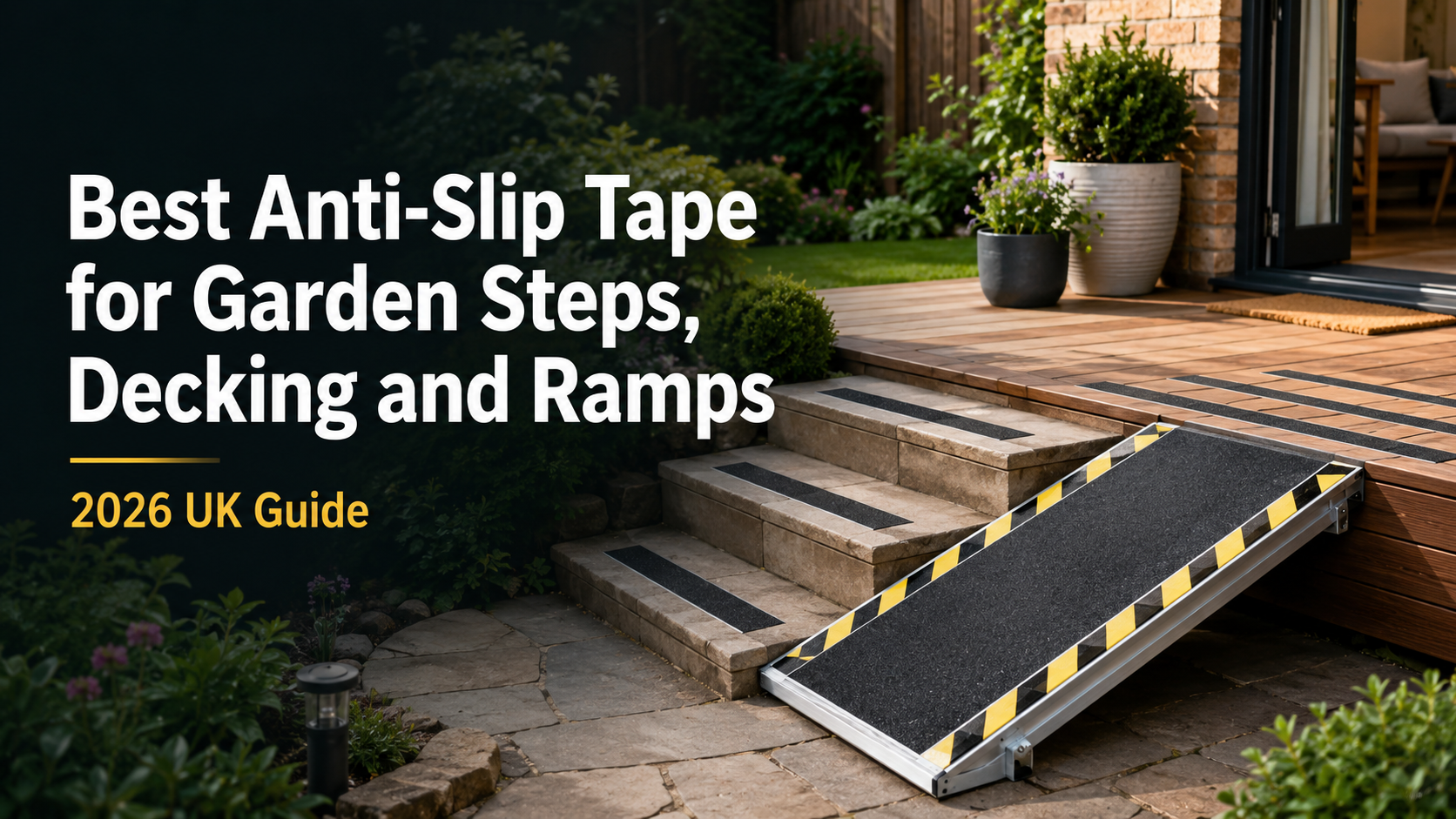
Decking and timber steps look fantastic in summer — right up until the first rain or a heavy morning dew turns them into a skating rink. Add a thin film of algae or moss, a pair of wet flip-flops and a tray of drinks, and a garden step quickly becomes one of the most common places people slip at home. The good news is that you don’t need to rip up your decking or call in a contractor to fix it. A roll of quality anti-slip tape, applied properly, restores grip in an afternoon for a few pounds a metre.
This guide explains exactly which type of anti-slip tape to use for garden steps, decking, ramps and wet areas, how much you need, and the prep steps that make the difference between tape that lasts years and tape that peels off by autumn.
Why outdoor steps, decking and ramps get so slippery
Timber and composite decking are smooth by design, and that smoothness gets worse with age. Three things work against you outdoors:
- Algae and moss. North-facing or shaded decking holds moisture, and a near-invisible film of green algae is incredibly slick when wet. It’s the single biggest cause of slippery decking in the UK climate.
- Water and dew. Even clean timber loses grip when it’s wet. Painted or oiled boards are worse still, because the finish seals the surface and removes any natural texture.
- Weathering. Years of foot traffic polish the high points of the grain smooth, while UV and rain break down any anti-slip coating you may have applied previously.
Pressure washing and anti-slip paint help for a while, but they wear off and the algae comes back. Anti-slip tape gives you an immediate, hard-wearing grip surface you can refresh whenever you need to — no drilling, no specialist tools.
What is anti-slip tape and how does it work?
Anti-slip tape (also called safety tread, grip tape or non-slip tape) is a tough backing coated with a gritted, abrasive surface — usually a mineral such as aluminium oxide or silicon carbide — bonded to a strong pressure-sensitive adhesive. You clean the surface, peel the liner and press it down. The grit gives the sole of a shoe (or a bare foot) something to bite into, even when the surface is wet.
Quality matters here, because outdoor tape has to survive rain, UV, frost and constant footfall. PSA Solutions’ anti-slip safety tread tape range uses a modified solvent-acrylic adhesive that grips low-energy surfaces like sealed timber far better than cheap budget rolls, which is why it stays put outdoors rather than curling at the edges after a fortnight.
Which grade of anti-slip tape do you need?
This is the question that trips most people up. The right tape depends on the surface, the location and whether people will be barefoot. PSA stocks three main options:
Multi-Surface anti-slip tape — the all-rounder for gardens
For most decking, garden steps, patio steps, garden paths and shed or mobility ramps, the Multi-Surface anti-slip tape is the one to reach for. It’s a permanent, hard-wearing grit tape with a strong solvent-acrylic adhesive, designed for demanding outdoor use — children’s play areas, decking, boat decks, ladders and patio steps included. It’s available in 25mm and 50mm widths on 18-metre rolls.
Swimming Pool Grade — for wet areas and bare feet
Around hot tubs, pool surrounds, washrooms and any genuinely wet area, step up to the Swimming Pool Grade anti-slip tape. It’s formulated specifically for wet environments and pool steps, with a grit profile chosen to grip reliably underwater and around standing water. It comes in 25mm, 50mm, 75mm and 100mm widths.
Tenura comfort strips — kinder underfoot
Standard grit tape is brilliant for shoes but harsh on bare feet, knees and paws. For bathrooms, wet rooms, paddling-pool steps and anywhere people go barefoot, the Tenura self-adhesive anti-slip strips give a softer, rubberised grip that’s far more comfortable while still slip-resistant. They come as 30 pre-cut die-cut strips on a roll — handy for stair treads where you don’t want to cut your own.
Best anti-slip tape for each job
- Decking steps and stair edges: Run a 50mm or 75mm strip along the front edge (the nosing) of each step — this is where most slips happen. Multi-Surface grade is ideal.
- Whole decking boards or walkways: Lay 50mm or 100mm strips in parallel runs across the traffic route. Wider Swimming Pool Grade gives maximum coverage on larger areas.
- Wheelchair, mobility and shed ramps: Cover the full ramp width with overlapping or closely-spaced strips so a wheel or foot is always on grip. Multi-Surface or Swimming Pool Grade depending on how wet it gets.
- Pool surrounds, hot tubs and wet rooms: Swimming Pool Grade for shoes, Tenura strips where bare feet land.
- Ladders and boat decks: Multi-Surface grade handles the flex and weather.
What width do you need, and how much?
PSA’s rolls come in 25mm, 50mm, 75mm and 100mm widths, all on 18-metre rolls. As a rough rule:
- Step edges only: 50mm is the sweet spot — visible, grippy and economical. One 18m roll covers around 18 standard step nosings.
- Full step coverage or ramps: 75mm or 100mm.
- Tight repairs and small treads: 25mm.
Measure the total length you want to cover, then add 10% for cutting and overlaps.
Don’t forget visibility after dark
A garden step you can’t see at dusk is just as dangerous as a slippery one. Two simple upgrades:
- Glow-in-the-dark tape: Mark step edges with glow-in-the-dark (photoluminescent) tape so they’re clearly visible after sunset without any wiring or power. It charges from daylight and glows for hours — ideal for garden steps, decking edges and pathways.
- Hazard colours: PSA’s anti-slip tape is available in high-visibility yellow as well as black, so you can make a step edge obvious in daylight too.
Pairing glow tape on the riser with grit tape on the tread gives you a step that’s both safe to see and safe to stand on.
How to apply anti-slip tape so it actually lasts
This is where most DIY jobs go wrong. Grit tape is only as good as the surface you stick it to, and outdoor timber is porous, dusty and often damp. Follow these steps:
- Choose a dry spell. Apply when the timber is dry and the temperature is above about 10°C. Avoid sticking tape down in the rain or on a cold morning — adhesives need warmth to bond.
- Clean thoroughly. Sweep, then scrub off all algae, moss and grease. Let it dry completely. Wipe the final surface with IPA cleaning wipes or a surface cleaner to remove the last of the dust and oils — this single step makes the biggest difference to how long the tape stays put.
- Prime porous surfaces. Bare timber, concrete and stone soak up adhesive and cause edges to lift. Sealing them first with a tape surface primer dramatically improves adhesion on decking.
- Round the corners. Snip the corners of each strip into a slight curve before applying — square corners are the first thing to catch a shoe and start peeling.
- Press firmly. Apply with steady pressure along the whole strip; a wallpaper seam roller works well. Don’t walk on it for a few hours while the adhesive grabs.
- Seal the edges in busy spots. On heavily-used steps and ramps, run a bead of edge fix sealer around the perimeter to lock the edges down and stop water creeping underneath.
How long does anti-slip tape last outdoors?
With proper prep, edge sealing and a primer on porous decking, a good-quality grit tape will give you several seasons of reliable grip. It’s an honest trade-off worth understanding: tape is the fastest, cheapest, no-drill way to make steps safe, and refreshing a strip now and then costs very little. In the busiest commercial settings some people fit permanent screw-down treads, but for garden steps, domestic decking, paths and ramps, anti-slip tape is the practical choice that the vast majority of homeowners reach for — and it’s far kinder to your decking than drilling holes through every board.
Quick recommendations
- Most garden steps and decking: 50mm Multi-Surface anti-slip tape
- Pool, hot tub and wet areas: Swimming Pool Grade anti-slip tape
- Barefoot and bathroom use: Tenura comfort strips
- Night visibility: Glow-in-the-dark tape
- For longevity: surface primer + edge fix sealer
Frequently asked questions
Does anti-slip tape work on wet decking? Yes — that’s exactly what it’s designed for. The gritted surface gives grip even when the decking is wet, which bare or oiled timber can’t. For genuinely wet areas like pool surrounds, use Swimming Pool Grade.
Will it work in winter and frost? Once it’s down and bonded, quality anti-slip tape keeps gripping through rain, frost and cold. Just make sure you apply it during a dry, mild spell so the adhesive bonds properly in the first place.
What grit or grade do I need for a garden? For most domestic decking, steps, paths and ramps, the Multi-Surface grade is ideal. Choose Swimming Pool Grade for wet areas, and the softer Tenura strips for anywhere people go barefoot.
How long does anti-slip tape last outside? Several seasons with good surface prep, a primer on porous timber and edges sealed in high-traffic spots. It’s quick and inexpensive to refresh a strip when grip starts to fade.
Can I put anti-slip tape on painted or oiled decking? Yes, but clean it well and prime first — sealed and finished surfaces are “low energy” and need a primer for the adhesive to grip reliably.
What width should I use for step edges? 50mm is the most popular choice for step nosings: wide enough to be safe and visible, economical enough to do a whole flight from one 18-metre roll.
Need help choosing the right grade or width for your project? PSA Solutions are anti-slip tape suppliers based in Leicestershire, with the full range in stock and usually dispatched within 2–3 working days. Browse the anti-slip tape range or get in touch with the team for free advice. For more practical guides, visit the Adhesive Advice Centre.

Add comment