
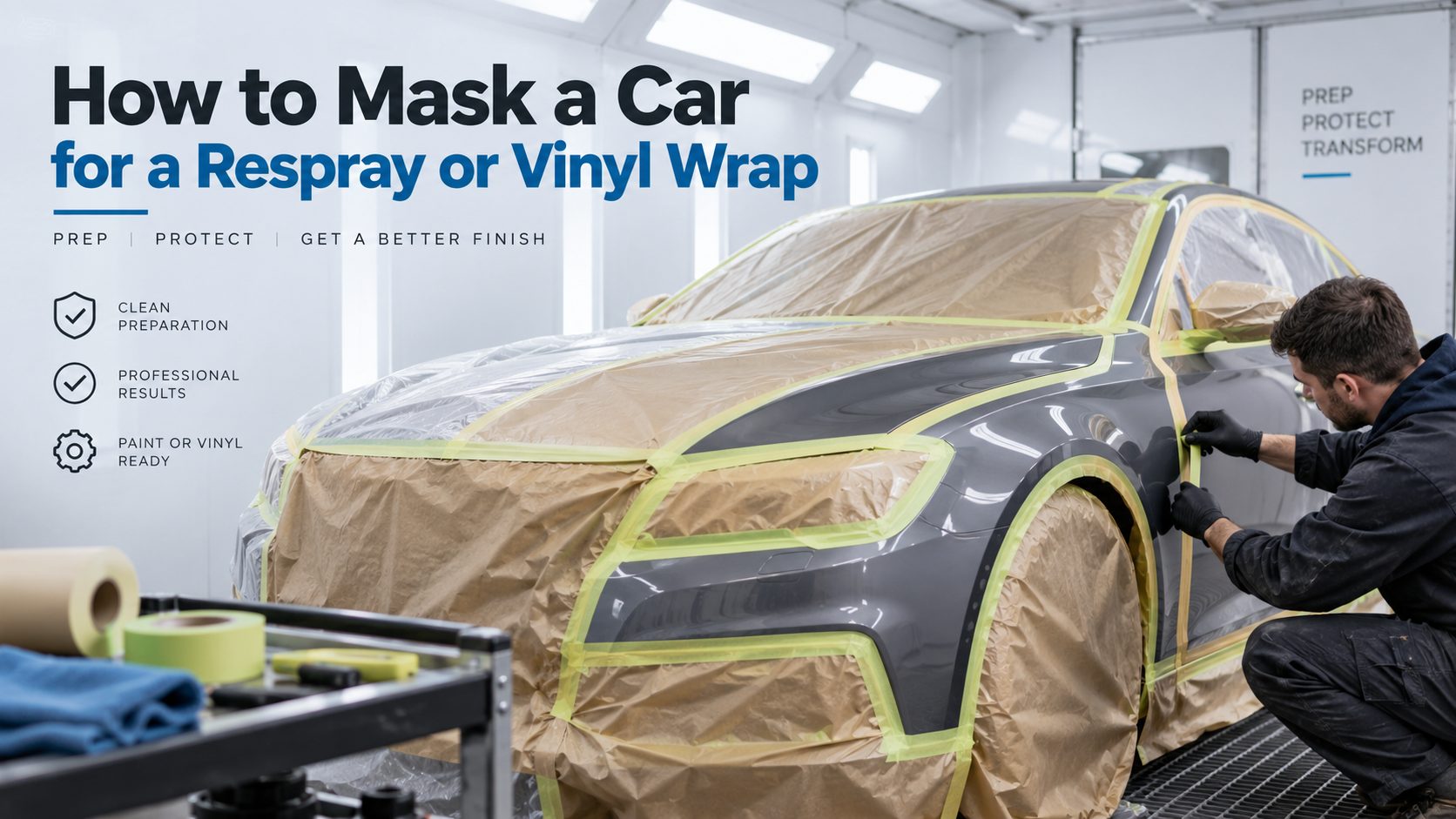
A great respray or vinyl wrap is won or lost at the masking stage. Spend the time to mask properly and you get crisp, clean paint edges, no overspray and a finish that looks like it came out of a professional booth. Rush it — or, just as commonly, use the wrong tape — and you get paint bleeding under the edges, ragged lines, lifted tape and, worst of all, adhesive baked hard onto the glass and trim.
This guide covers how to mask a car properly for both a respray and a vinyl wrap, and, crucially, which tapes to use for each job — because the single most common masking mistake is reaching for the wrong roll.
The golden rule: never use household masking tape
Ordinary beige masking tape from the DIY aisle is designed for one thing: decorating a room at normal temperature. Put it anywhere near automotive paintwork and it lets you down badly. In a bake oven or under a heat lamp its rubber adhesive softens, bakes onto the surface and leaves a residue you’ll spend hours scrubbing off. Its edges lift and let paint bleed underneath, and it tears instead of peeling cleanly.
Automotive masking tapes are built for the job — they withstand the heat of a drying cycle, resist paint and thinners, follow curves, and peel away cleanly with no residue. They cost very little more and they’re the difference between a sharp finish and a ruined one.
The tapes you need
There are three automotive masking tapes worth knowing, and a good respray often uses all three.
High-temperature automotive masking tape
This is the everyday workhorse for respray masking. PSA’s high-temperature automotive masking tape is a yellow crepe paper tape with a rubber-based adhesive, developed primarily for spray painting in high-temperature environments up to around 110°C — so it survives a bake oven — while peeling cleanly with no residue and working with both water- and solvent-based paints. It comes in a full range of widths on 50-metre rolls: 19mm and 24mm for edging and detail, 36mm and wider for holding masking paper. It’s one of PSA’s best-sellers for good reason.
Low bake masking tape
If you’re drying at lower temperatures — using heaters, dryers or infrared lamps rather than a full bake oven — a low bake masking tape is the right choice. It’s a semi-crepe tape with a solvent rubber-resin adhesive, temperature-resistant up to around 80°C for an hour, with excellent holding power and strong resistance to thinners and lacquers. Body shop painters like it because it won’t fail when the heat goes on.
The simple rule: match the tape’s temperature rating to your drying process. Push a tape beyond its rating and the adhesive starts to transfer and bake on.
Fine line masking tape
For the precision work, you need fine line masking tape — a thin, flexible film tape that’s the secret to razor-sharp edges. Because it’s thinner and far more flexible than crepe tape, it stretches smoothly around tight curves and contours without lifting or wrinkling, giving perfectly crisp paint lines. It’s what you reach for on two-tone splits, custom stripes, feature lines and any curved edge, and it comes in 6mm, 9mm and 12mm widths on 55-metre rolls. Used on smooth, high-energy surfaces like metal, it peels away leaving a clean, sharp line.
Don’t forget the paper and film
Tape alone doesn’t cover a panel. You’ll also want proper masking paper and masking film to cover the areas you’re not painting — never newspaper, which lets paint bleed through and can transfer print onto the car. Tape the paper and film down at every seam so there’s no route for overspray.
How to mask a car for a respray
- Clean and degrease first. Wash the car, then go over the areas around your paintwork with a panel wipe or IPA cleaning wipes to remove all wax, grease and polish. Finish with a tack cloth. Masking over a dirty or greasy surface means the tape won’t hold its edge. Work in a clean, dry, dust-free space.
- Remove rather than mask where you can. Badges, light units, door handles, trims and mirrors give a far better finish removed than masked around — you avoid a paint ridge and get full coverage. (When it’s time to refit badges and trim afterwards, an automotive double-sided foam tape is the correct way to bond them back on.) Mask only what you can’t practically remove.
- Edge the panels and burnish the tape down. Run your masking tape along every paint boundary, then press the edge down firmly with your fingernail or a plastic applicator. This burnishing is what stops paint creeping underneath — an un-burnished edge is the number-one cause of bleed.
- Use fine line tape for the sharp stuff. On curves, two-tone splits and stripes, lay fine line tape first for the crisp edge, then back it up with crepe tape and paper.
- Create soft edges where you’re blending. Where you want to fade an edge rather than leave a hard paint ridge, use a back-masking (reverse-rolling) technique so the tape lifts the spray slightly and feathers the edge.
- Cover everything else. Mask the glass, grilles, arches, door shuts and any gaps with paper and film, taping all the seams. Walk around the car and check there’s no exposed gap an overspray cloud could drift into.
Removing the tape — the bit people get wrong
How and when you pull the tape off matters as much as how you put it on:
- Pull it back on itself at a shallow angle, roughly 45 degrees, rather than straight up and out — that’s what gives a clean break in the paint line.
- Do it at the right time. The cleanest edge comes from removing the tape while the paint or lacquer is still slightly warm and not yet fully hardened. If the paint has fully cured and hardened over the tape, score gently along the edge with a sharp blade first, or you risk chipping the new paint as the tape tears away.
- Don’t leave it on for days, especially in sunlight — the longer tape sits, the harder it is to remove cleanly.
How to mask for a vinyl wrap
Wrapping is a different discipline — there’s no heat and no overspray — but masking and fine line tape still earn their place:
- Alignment and hinges. Masking tape is used to mark your position and create “hinge” points, so you can lift a large panel of vinyl, position it precisely and lay it down without it sticking out of place.
- Protecting edges when you trim. When cutting vinyl on the car, tape protects the adjacent paintwork and trim from the blade. Cutting directly on the paint risks scoring it, so many wrappers use a knifeless-tape method or a dedicated wrap-safe technique rather than a bare blade — take real care here.
- Marking cut lines and curves. Fine line tape is ideal for laying out precise, smooth cut lines and feature edges.
As with paint, the surface has to be spotless first: wash and degrease thoroughly, because vinyl will not stick reliably over any wax, grease or polish.
Pro tips for a flawless finish
- Burnish every tape edge — unpressed edges bleed.
- Don’t stretch crepe masking tape as you apply it; stretched tape pulls back and lifts. (Fine line film is designed to flex, so it’s the exception on curves.)
- Overlap paper seams away from the spray direction so overspray can’t drive into a joint.
- Replace any tape that lifts rather than hoping it holds.
- Use the right width — narrow tape for edging and detail, wider tape and paper for coverage.
- Work methodically around the car and double-check before you spray or wrap.
A word on safety
Spray painting isn’t just a tape-and-technique job — it carries real health risks. Paint overspray and solvent fumes are hazardous, and two-pack (2K) paints contain isocyanates, which are dangerous to breathe and require proper air-fed respiratory protection, not just a dust mask. Spray only in a properly ventilated space or booth, wear the correct respirator and PPE for the paint you’re using, and don’t attempt to spray 2K without the right equipment. If in doubt, leave the spraying to a professional body shop.
Frequently asked questions
Can I use normal masking tape to spray paint a car? No. Household masking tape softens and bakes on in the heat of a drying cycle, leaves residue, and lets paint bleed under the edge. Use a high-temperature automotive masking tape rated to around 110°C, or a low bake tape for lower-temperature drying.
What’s the difference between low bake and high-temperature masking tape? It’s the temperature rating. Low bake tape handles drying cycles up to around 80°C and suits heater, dryer and infrared-lamp drying; high-temperature tape handles up to around 110°C for hotter bake ovens. Match the tape to your process.
What is fine line tape used for? Creating sharp, precise paint edges — especially on curves, two-tone splits and stripes. It’s a thin, flexible film tape that bends around contours without lifting or wrinkling, leaving a crisp line that crepe tape can’t match.
When should I remove the masking tape after painting? For the cleanest edge, peel it back on itself while the paint or lacquer is still slightly warm and not fully hardened. If it’s already fully cured, score along the tape edge with a sharp blade first to avoid chipping the new paint.
How do I get a sharp two-tone paint line? Lay fine line tape for the edge, burnish it down firmly so no paint can creep under, spray, and remove the tape at the right time by pulling it back on itself. That combination gives the crisp division between colours.
What tape do I use for a vinyl wrap? Masking and fine line tape for marking alignment, creating hinge points to position panels, and protecting adjacent paint and trim when you trim the vinyl. Take care cutting on the car so you don’t score the paint beneath.
PSA Solutions are automotive masking tape suppliers based in Leicestershire, stocking high-temperature, low bake and fine line tapes — all best-sellers — in stock and usually dispatched within 2–3 working days. Not sure which tape or width you need? Contact the team for free advice, and visit the Adhesive Advice Centre for more practical how-to guides.


Add comment