
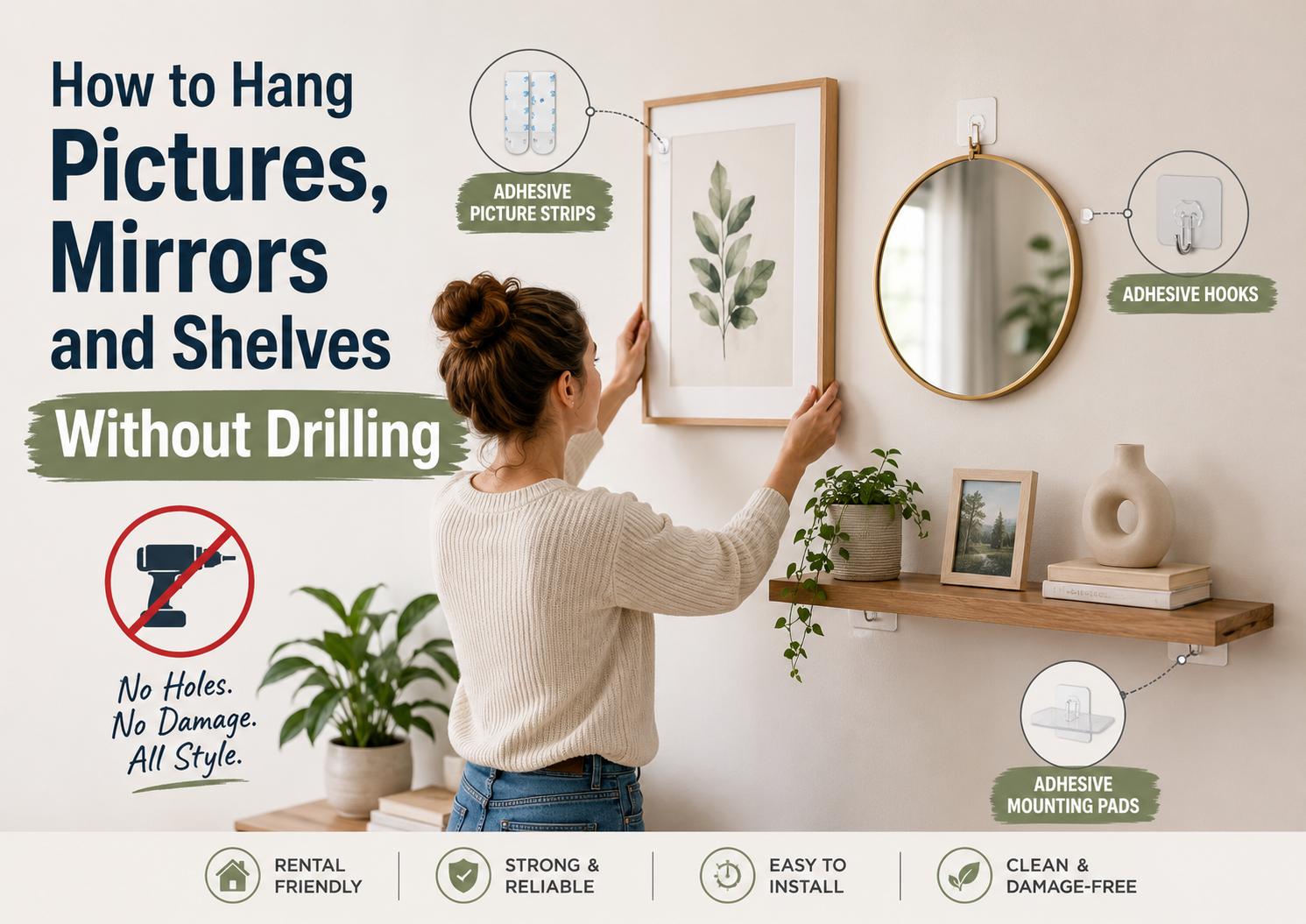
Whether you’re renting and can’t put holes in the walls, you’d rather not lose your deposit, or you simply don’t fancy the dust, drilling and rawl plugs, hanging things without a single hole has never been more doable. Modern adhesive tapes are strong enough to hold picture frames, lightweight mirrors and small shelves securely — provided you pick the right tape for the job, prep the surface properly, and stay honest about weight.
That last point is where most no-drill jobs go wrong. This guide walks you through which tape suits which item, how to apply it so it actually holds, and how to remove it cleanly when you move out or fancy a change.
Can you really hang things with tape?
Yes — within sensible limits. Adhesive tape is brilliant for lightweight-to-medium items: framed prints, posters, canvases, small mirrors, hooks, decorative pieces and light floating shelves. Two things decide whether it works:
- Weight. Tape has to support the load in “shear” (the item trying to slide down the wall). The heavier the item, the more tape area you need — and beyond a certain point, tape simply isn’t the right tool.
- The wall surface. This is the one people forget. The tape doesn’t bond to the wall itself, it bonds to whatever is on the wall — the paint, the wallpaper, the dust. Your hold is only ever as strong as that surface.
Get both right and a taped-up frame will stay put for years. Get them wrong and it’ll be on the floor by morning.
The golden rule: match the tape to the weight — and never overload
Before anything else, a safety point worth stating plainly: never hang a heavy mirror or a loaded shelf on tape alone. A large mirror coming off a wall is heavy, sharp and dangerous, especially above a bed or sofa. For anything substantial, use proper mechanical fixings, or a hybrid approach where a bracket takes the weight and tape steadies it. Tape is for lightweight and medium items — keep it there and it won’t let you down.
If you’re unsure whether a particular tape will hold a particular item, it’s always worth a quick call to a supplier for guidance before you commit.
Which tape for which job
This is the part that makes or breaks the result. Different jobs need different adhesives:
Lightweight frames, prints, posters and décor → high-grab foam tape
For everyday picture-hanging, a high-grab double-sided foam tape is the workhorse. The foam core conforms to slightly uneven surfaces, cushions the bond, and it’s moisture-, UV- and temperature-resistant, so it’s happy indoors or out. It mounts invisibly behind the frame for a clean finish. The 19mm × 50m roll is ideal, and for small, light pieces a few double-sided foam pads in the corners do the job.
Heavier frames, lightweight mirrors and glass → structural acrylic gel tape
When you need a stronger, more permanent bond, step up to a structural acrylic gel tape. PSA’s No Nails Needed kit is purpose-made for this — a roll of high-bond gel tape supplied with a surface-prep wipe and instructions, designed to replace mechanical fixings for DIY jobs around the home. For mirrors and glass, the clear gel foam tape gives an invisible bond line, and the wider structural acrylic range covers heavier or trickier surfaces. Even so, keep mirrors light and follow the safety rule above.
Porous or uneven walls → Super Tape
If you’re sticking to a slightly porous or uneven surface — bare-ish plaster, a painted table, MDF — Super Tape is “no nails on a roll”: a 700-micron double-sided tape with an internal scrim that grips almost any substrate with a bond close to a mechanical fixing. One thing to note: it’s a rubber-based adhesive, so avoid using it anywhere exposed to strong sunlight or heat — a sunny windowsill or conservatory wall will shorten its life. For those spots, use the UV-resistant high-grab foam instead. The 25mm × 25m roll suits most jobs.
Renters, or anything you’ll reposition → hook & loop
If avoiding wall damage is the priority, or you like to swap things around, self-adhesive hook & loop tape is the renter’s best friend. It secures small-to-medium frames and lightweight mirrors without nails or wall plugs, and the two halves separate cleanly so you can lift the item off and put it back without re-doing the adhesive. It’s removable, repositionable and kind to your deposit — browse the full hook & loop range for the right width.
Check your wall first
Because the tape bonds to the surface finish, the wall has to be sound, smooth, clean and dry. A two-minute check here saves a lot of frustration:
- Good surfaces: smooth painted plaster, eggshell or gloss, tile, glass, melamine and laminate.
- Poor surfaces: flaky or chalky old paint, loose or textured wallpaper, woodchip, heavily textured plaster, and limewash or distemper — the tape pulls the loose layer off rather than holding.
- Freshly painted walls: let new paint cure fully for two to four weeks before applying tape. Uncured paint still off-gasses and the tape won’t bond reliably.
If your wall is textured or papered, hook & loop with a generous contact area is your most forgiving option — but a genuinely loose or dusty surface won’t hold any tape well.
How to hang it so it stays put
You’ll need your chosen tape, IPA cleaning wipes or a surface cleaner, a pencil, a spirit level, a tape measure and some masking tape.
- Clean both surfaces. Wipe the wall and the back of the item with IPA to remove dust, grease and polish, and let them dry. This single step is the biggest factor in how well the bond holds.
- Plan the position. Measure, mark lightly with a pencil, and use a spirit level — once high-bond tape is on, you won’t get a second go at straightening it. A strip of masking tape on the wall makes a handy alignment guide.
- Apply tape to the item, not the wall. Spread the coverage: run strips along the top and bottom of a frame, or place a pad near each corner, so the load is shared and no edge can peel. Heavier items need more tape area.
- Press firmly — really firmly. These adhesives are pressure-activated, so the harder you press, the stronger the bond. Hold the item against the wall with even pressure across the whole contact area for at least 30 seconds.
- Let it cure before loading. Gel and acrylic tapes build towards full strength over the following 24–72 hours. Don’t hang anything heavy on a hook, or place items on a shelf, until the bond has had time to set.
For shelves, take extra care: keep loads light, use full-length tape along the bracket or batten, do a gentle test-load before trusting it, and for anything beyond ornaments consider a bracket that carries the weight with tape steadying it.
Removing it cleanly later
This is where the no-drill approach really pays off for renters. To take tape down without marking the wall:
- Warm it first. A hairdryer on a low setting softens the adhesive.
- Peel slowly back on itself at a shallow angle, rather than yanking straight out — pulling outward is what lifts paint.
- For foam pads, work a length of dental floss or fishing line behind and “saw” through the bond.
- Clean any residue with a suitable adhesive remover, then a wipe of IPA.
Always test on an inconspicuous patch first, and remember that hook & loop is the most damage-free option of all, since the adhesive stays put while the item simply unclips.
Quick recommendations
- Light frames, prints, décor: high-grab foam tape or foam pads
- Heavier frames and lightweight mirrors: No Nails Needed gel kit / clear gel tape
- Porous or uneven indoor surfaces: Super Tape
- Renters and repositionable hangs: self-adhesive hook & loop
Frequently asked questions
Can you hang a mirror with double-sided tape? A small, lightweight mirror, yes — use a high-bond structural acrylic or clear gel tape, prep both surfaces thoroughly, and spread the tape across the back. For any large or heavy mirror, don’t rely on tape alone; use mechanical fixings or a tape-and-bracket combination for safety.
How much weight can adhesive tape hold? It depends on the tape, the area used and the surface it’s stuck to, so there’s no single figure. The practical approach is to match plenty of tape area to the weight, never overload, and pick a high-bond tape for heavier items. For a specific load, ask the supplier to confirm the right product.
Will it damage the paint or wall when I take it down? Removed carefully — warmed with a hairdryer and peeled slowly back on itself — tape usually comes off cleanly from a sound surface. Hook & loop is the most damage-free choice. Flaky or freshly painted walls are the most likely to lift, so test first.
Can I use tape on textured walls or wallpaper? Smooth, sound surfaces hold best. Foam tape copes with minor texture, but woodchip, heavy texture and loose or peeling wallpaper are poor candidates — the tape grips the loose layer rather than the wall.
How long before I can let go or load a shelf? Press the item firmly on application, then let high-bond gel and acrylic tapes cure for 24–72 hours before hanging weight or loading a shelf, so the bond reaches full strength.
What’s the best tape for renters who can’t drill? Hook & loop for anything you want to remove or reposition without a mark, or high-grab foam and the No Nails gel kit where you want a firmer, longer-term hold while still being able to take it down cleanly later.
PSA Solutions are adhesive tape suppliers based in Leicestershire, with the full range of mounting tapes in stock and usually dispatched within 2–3 working days. Not sure which tape suits your frame, mirror or shelf? Contact the team for free advice on the right product and hold for the job, and visit the Adhesive Advice Centre for more practical how-to guides.



Add comment