
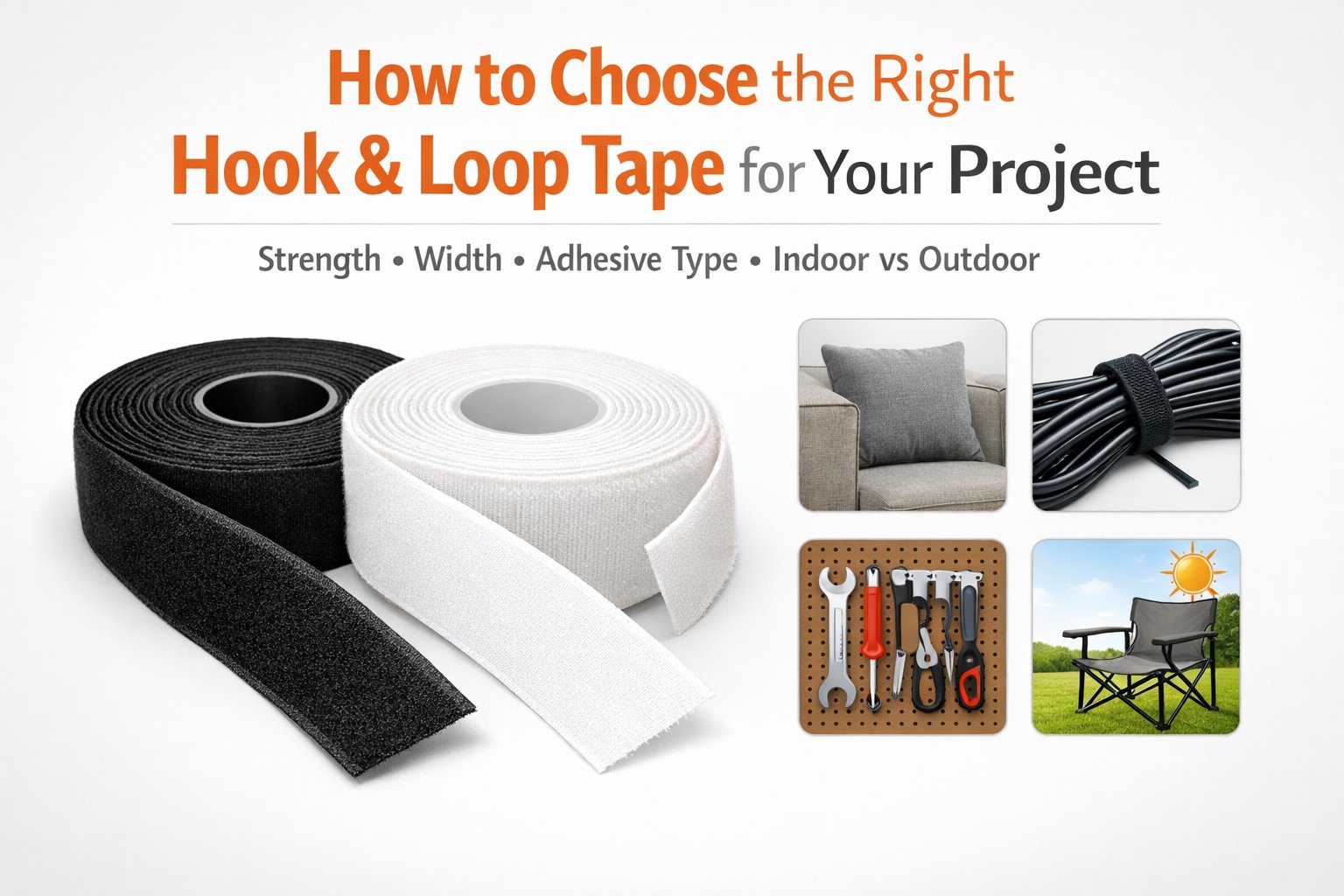
How to Choose the Right Hook & Loop Tape for Your Project
Hook and loop tape is one of the most versatile fastening products available — but with rolls ranging from 20mm to 100mm wide, coins in three different diameters, and a choice between rubber and acrylic adhesives, picking the right product for your specific job isn’t always straightforward.
Choose a tape that’s too narrow and the bond won’t hold. Go too wide and you’ll spend more than you need to on material that doesn’t improve performance. Use the wrong adhesive on the wrong surface and the whole thing fails within days.
This guide walks you through the key decisions — width, adhesive type, format, and surface compatibility — so you can match the right tape to your project with confidence, whether you’re hanging a Roman blind at home or mounting exhibition panels at the NEC.
Start With the Weight: What Are You Fastening?
The single most important factor in choosing hook and loop tape is the weight of the item you’re mounting. A heavier item needs a wider tape — not because the hook and loop grip itself is stronger at wider widths, but because a wider strip gives the adhesive more surface area to bond with, distributing the load more evenly and reducing the risk of edge peel.
As a general rule:
Lightweight items (under 500g) — remote controls, small picture frames, cable tidying, labels, name badges, and lightweight signage. A 20mm tape is more than sufficient. It keeps a low profile and won’t overwhelm small surfaces.
Light to medium items (500g–2kg) — Roman blinds, curtain pelmets, Foamex display boards, notice boards, small mirrors, and seat cushions. Our 25mm tape is the most popular width for this range — it provides a solid hold without being visually intrusive. For items at the heavier end, or fastenings that will be opened and closed regularly, the 30mm tape adds a useful margin of security.
Medium to heavy items (2kg–5kg) — bath panels, large display boards, radiator covers, uPVC window panels, automotive trim, and medium-weight signage. This is where you need to step up to 38mm or 50mm tape. The extra width distributes the load across a broader bonding area, preventing the edges from peeling under sustained weight.
Heavy items (5kg+) — full-size exhibition panels, acoustic boards, heavy signage, industrial equipment covers, insulation boards, and large mirrors. Use 50mm or 100mm tape. At this weight class, the adhesive contact area is critical — a narrow tape simply doesn’t have enough surface to maintain a reliable hold over time.
When in doubt, go one width up from what you think you need. The additional material cost is minimal, and an over-specified fastening that holds firm is always better than an under-specified one that fails.
Width-by-Width: What Each Tape Size Is Designed For
Here’s a practical breakdown of each width in our self adhesive hook and loop tape range and the applications it’s best suited to.
20mm — The Slim, Discreet Option
At just under an inch wide, the 20mm tape is designed for lightweight jobs where a low-profile finish matters. It’s barely visible once applied, making it ideal for mounting remote controls to walls, tidying cables behind entertainment units, fixing lightweight picture frames, attaching tool holders in workshops, and creating removable mosquito screens on window frames.
Best for: Items under 500g on smooth, clean surfaces where the tape needs to stay hidden.
25mm — The All-Rounder
The 25mm tape is our best seller for good reason. At exactly 1 inch wide, it strikes the right balance between holding strength, visual discretion, and value. It’s the standard choice for exhibition graphics and Foamex boards, Roman blinds, curtain pelmets, notice boards, and general-purpose domestic and commercial fastening.
Best for: Everyday fastening across home, office, and exhibition environments. If you’re unsure which width to choose and your item is light to moderate weight, start here.
30mm — The Step Up for Medium Duty
The 30mm tape provides roughly 20% more adhesive contact area than the 25mm. That modest increase makes a real difference for items that sit at the upper end of what a 1-inch tape can comfortably hold. It’s the go-to width for bath panels, carpet edges and stair runners, radiator covers, draught excluders, and medium-weight display boards in high-traffic areas.
Best for: Domestic panel mounting (especially bathrooms), flooring edges, and display work where a little extra holding strength is needed.
38mm — Where Trade and Industrial Begins
The 38mm tape is the first width in the range that’s genuinely built for trade use. Over 50% wider than the 25mm, it handles the loads and handling frequency that lighter tapes can’t sustain. This is the preferred width for uPVC window panels and secondary glazing, large exhibition graphics, automotive interior trim, conservatory blinds, equipment enclosures, and heavy domestic items like headboards and large mirrors.
Best for: Trade professionals, uPVC and glazing work, automotive applications, and heavy-duty domestic mounting.
50mm — Professional Heavy Duty
At 2 inches wide, the 50mm tape is purpose-built for professional environments. It’s the width most commonly specified by exhibition contractors, commercial fit-out teams, and facilities managers. Core applications include full-size exhibition panels and wall systems, acoustic panels and soundproofing boards, conference backdrops and event staging, machine guards and industrial access panels, and insulation board mounting.
Best for: Exhibition build, commercial interiors, acoustic treatment, and industrial maintenance.
100mm — Maximum Hold
The 100mm tape is the widest in our range and exists for applications where nothing less will do. A single 100mm strip delivers five times the bonding surface of a 20mm strip. It’s used for full-panel wall mounting in exhibition and retail, heavy acoustic absorbers and bass traps, large industrial enclosures and equipment covers, vehicle and marine interior panels, and warehouse-scale signage and safety boards.
Best for: The heaviest, largest, and most demanding fastening applications. Professional use only — if your items are under 5kg, a narrower tape will do the job at lower cost.
Rolls vs Coins: Which Format Do You Need?
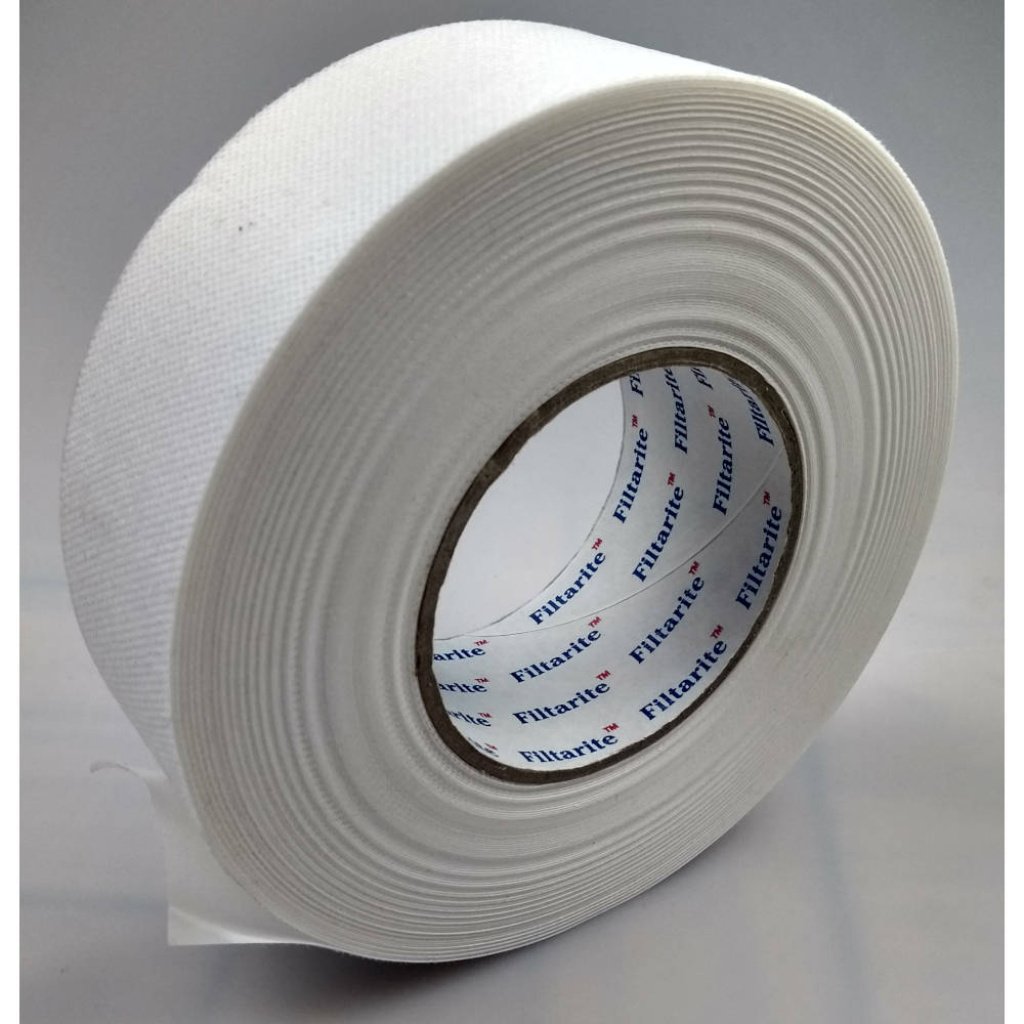
Hook and loop tape comes in two formats — continuous rolls and pre-cut coins (also called dots or spots). The right choice depends on the shape and size of your fastening area and how many items you’re attaching.
When to Use Rolls
Rolls are the better choice when you need to fasten items along an edge or a continuous line — a bath panel across its top edge, a Roman blind along a headrail, a display board along its full width, or a cable trunking run along a wall. You cut the tape to exactly the length you need, which means zero waste and complete flexibility.
Rolls are also more cost-effective per square centimetre of adhesive coverage, especially on larger jobs.
Use rolls when: The fastening runs in a line, you need a custom length, or the item is heavier and needs maximum contact area.
When to Use Coins
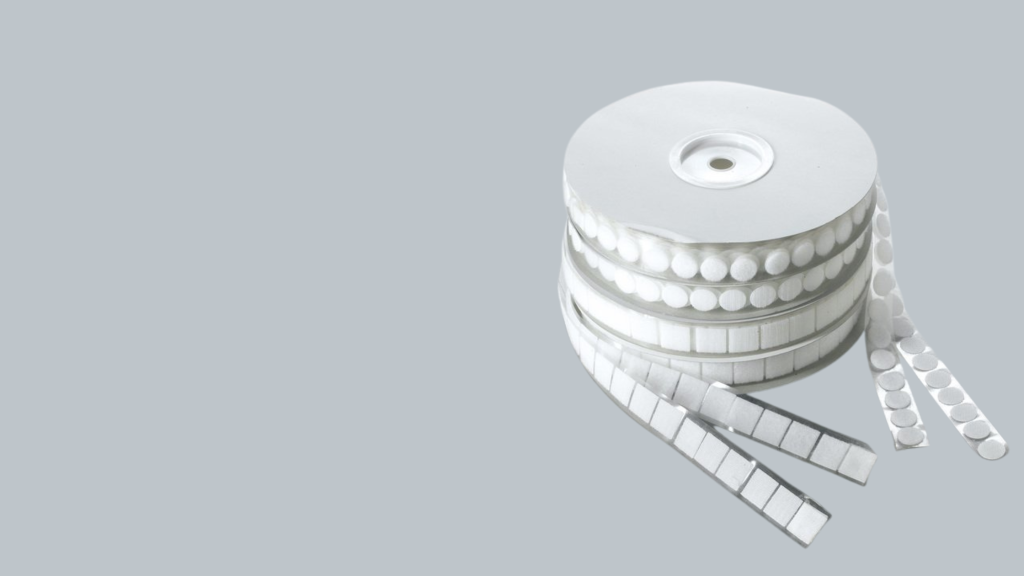
Coins are pre-cut circles of hook and loop tape with adhesive backing, available in 13mm, 16mm, and 22mm diameters. They’re faster to apply than cutting strips from a roll and produce a neater result when you only need a fastening at specific points — such as the corners of a panel, the back of a product box, or individual mounting spots on a display board.
Coins are particularly popular in retail packaging, point of sale, craft, educational materials, and any application where you’re attaching a large number of lightweight items at individual fixed points.
Use coins when: You need fastening at specific spots (not a continuous line), you’re applying to many items quickly, or the item is lightweight and doesn’t need full-edge coverage.
Can You Combine Both?
Absolutely. A common approach for bath panels and access hatches is to run a continuous strip of tape along the top edge for primary support, then use coins at the bottom corners to hold the panel flush against the frame. This gives you the full-length hold of a roll where it matters most, with the speed and neatness of coins at secondary fixing points.
Rubber vs Acrylic Adhesive: What’s the Difference?
All of our self adhesive hook and loop tapes come with a rubber-based pressure sensitive adhesive as standard. This is the right choice for the vast majority of applications — but for specific environments, an acrylic adhesive may be worth considering.
Rubber Adhesive (Standard)
Rubber adhesive is our default for good reason. It provides excellent initial tack — the adhesive grips firmly the moment you press the tape onto a surface — and delivers strong, reliable performance on smooth substrates in normal indoor and outdoor environments.
Strengths:
- High initial grab — bonds firmly on first contact
- Strong performance across most common surfaces
- Good adhesion to low energy substrates (polypropylene, polystyrene, etc.)
- Cost-effective
- Suitable for indoor and outdoor use
Limitations:
- Degrades under prolonged direct UV exposure
- Not ideal for extreme temperature ranges (sustained heat above 60°C or cold below -10°C)
- Can soften in very high humidity over extended periods
Use rubber adhesive for: Most domestic, commercial, exhibition, and light industrial applications. If you’re working indoors, in a covered outdoor area, or in normal temperature and humidity conditions, rubber is the right choice.
Acrylic Adhesive (On Request)
Acrylic adhesive is a premium option that outperforms rubber in extreme or long-term environments. It builds bond strength progressively over 24–72 hours and provides superior resistance to UV, temperature extremes, and chemical exposure.
Strengths:
- Excellent UV resistance — won’t degrade in sustained sunlight
- Wide temperature tolerance (typically -40°C to +120°C)
- Superior long-term durability — holds performance over years, not just months
- Better chemical and moisture resistance
Limitations:
- Lower initial tack than rubber — takes longer to reach full bond strength
- Higher cost
- Available on request rather than off-the-shelf
Use acrylic adhesive for: Permanent outdoor installations, signage exposed to direct sunlight, industrial environments with temperature extremes or chemical exposure, marine and vehicle exteriors, and any installation expected to remain in place for years without maintenance.
If you think you might need acrylic adhesive, contact us and we’ll advise on availability, lead time, and pricing for your specific tape width.
Matching Tape to Surface: What Sticks to What?
The adhesive is only as good as the surface it’s applied to. Our rubber adhesive bonds reliably to a wide range of smooth, clean substrates — but some surfaces require extra attention and others should be avoided entirely.
Surfaces That Work Well
- Metal — mild steel, aluminium, stainless steel, powder-coated, and anodised surfaces. Clean and degrease before application.
- Glass — clean with isopropyl alcohol and dry thoroughly. Avoid applying in cold conditions where condensation may be present.
- Rigid plastics — ABS, acrylic, polycarbonate, fibreglass/GRP, and composite panels (Dibond, aluminium composite). These are excellent substrates for hook and loop tape.
- Painted walls and plasterboard — the tape bonds well to smooth, well-cured paint. On freshly painted surfaces, allow at least two weeks for the paint to fully cure before applying tape.
- PVC and uPVC — commonly used in glazing and window applications. Remove any silicone residue before application.
- Sealed timber and MDF — sealed or varnished surfaces bond well. Unsealed or bare timber may absorb adhesive and reduce performance.
- Ceramic and glazed tiles — clean thoroughly and ensure the grout lines are avoided (the tape needs a flat, continuous surface).
- Low energy plastics — polypropylene, polystyrene, acetyl, PVA, and Teflon. The rubber adhesive is specifically formulated to grip these challenging surfaces.
Surfaces to Avoid
- Fabrics and textiles — the adhesive won’t bond reliably and may leave residue. For fabric applications, use our sew-on hook and loop tape instead.
- Dashboards and flexible vinyl — these surfaces are too soft and often contain plasticisers that break down adhesive.
- Dusty, greasy, or damp surfaces — the tape will bond to the dust or grease layer rather than the surface itself, leading to rapid failure. Always clean before application.
- Porous or textured surfaces — bare brick, rough concrete, and heavily textured plaster don’t provide enough flat contact area for the adhesive to grip. Consider mechanical fixings for these substrates.
The Golden Rule: Surface Preparation
Regardless of which tape width or adhesive you choose, surface preparation is the single biggest factor in whether your fastening holds or fails. Every surface should be cleaned with isopropyl alcohol, dried completely, and checked for dust, grease, and moisture before any tape is applied.
We’ve published a detailed Surface Preparation and Application Guide that covers the full process step by step.
How Much Tape Do You Actually Need?
A common question — especially on larger projects. Here’s a simple way to estimate.
For edge mounting (running tape along the top and/or bottom of a panel), measure the total linear length you need in metres and round up. A single 25-metre roll goes a surprisingly long way — it’s enough to run two strips along 12 panels that are 1 metre wide, for example.
For full-surface mounting (covering a large area for maximum hold), calculate the total surface area in square metres and divide by the tape width. For instance, 50mm tape provides 1.25 square metres of coverage per 25m roll (0.05m × 25m = 1.25m²).
If you’re working on a large project and want to make sure you order the right quantity, contact our team with your panel dimensions and we’ll calculate exactly what you need.
Common Mistakes to Avoid
We’ve seen these trip people up time and again. Avoiding them will save you time, money, and a failed fastening.
Skipping surface preparation. This is by far the most common cause of hook and loop tape failure. The adhesive is only as strong as the surface it’s bonded to — if there’s dust, grease, moisture, or soap residue under the tape, the bond will fail. Always clean with isopropyl alcohol and dry fully before applying.
Loading the tape too soon. The adhesive grips on contact, which gives the impression the bond is at full strength immediately. It isn’t. The rubber adhesive needs a full 24 hours to cure to maximum performance — 48 hours for wider tapes (50mm and 100mm) or cold environments. Mounting a heavy panel immediately after application is the second most common cause of failure.
Using tape that’s too narrow for the weight. A 20mm strip might hold a bath panel for a few days, but the concentrated load will eventually cause the edges to peel and the panel to fall. Match the tape width to the item weight — see the guide above.
Applying in cold conditions. Below 10°C, the adhesive’s initial tack drops significantly and curing time increases. If you’re working in an unheated warehouse, garage, or outdoor area in winter, extend the curing time to 72 hours or bring the tape to room temperature before application.
Expecting adhesive to work on dirty uPVC. Window frames often have a thin film of silicone, condensation residue, and dust that’s invisible but devastating to adhesive performance. Clean uPVC thoroughly with IPA before applying — this step alone is often the difference between a fastening that lasts years and one that fails within weeks.
Using self adhesive tape where sew-on tape is needed. If you’re attaching hook and loop to fabric — clothing, curtains, upholstery, soft furnishings — the adhesive version isn’t designed for this. It won’t bond reliably to textile surfaces and may leave sticky residue. Use sew-on hook and loop tape instead, or contact us for advice.
Quick Reference: Choosing at a Glance
| What You’re Fastening | Recommended Width | Format |
|---|---|---|
| Remote controls, cables, small labels | 20mm | Roll |
| Roman blinds, small display boards, notice boards | 25mm | Roll |
| Bath panels, carpet edges, radiator covers | 30mm | Roll |
| uPVC panels, large signage, automotive trim | 38mm | Roll |
| Exhibition panels, acoustic boards, machine guards | 50mm | Roll |
| Full wall panels, heavy industrial, large acoustic treatment | 100mm | Roll |
| Product packaging, POS tags, craft, educational materials | 13mm coins | Coin |
| Notices, brochures, lightweight panel corners | 16mm coins | Coin |
| Bath panel corners, access hatch points, heavier POS | 22mm coins | Coin |
| Cable bundling, server rooms, workshops | Cable ties | Tie |
Still Not Sure? We’ll Help You Choose
If you’ve read through this guide and you’re still not certain which tape is right for your project, get in touch. Our product support team has years of experience matching tape to application, and we’re happy to recommend the right product based on your specific weight, surface, and environment — no charge, no obligation.
Contact us by phone or email, or use the enquiry form on any product page.
PSA Solutions Ltd are self adhesive hook and loop tape suppliers based in Leicestershire, UK. We stock a full range of hook and loop tape rolls, coins, and cable ties in our Leicester warehouse, with free mainland UK shipping on orders over £60 and next day delivery available on orders placed before 12pm.


Add comment